Chaco Canyon Astronomy: How Ancient Puebloans Mapped the Stars
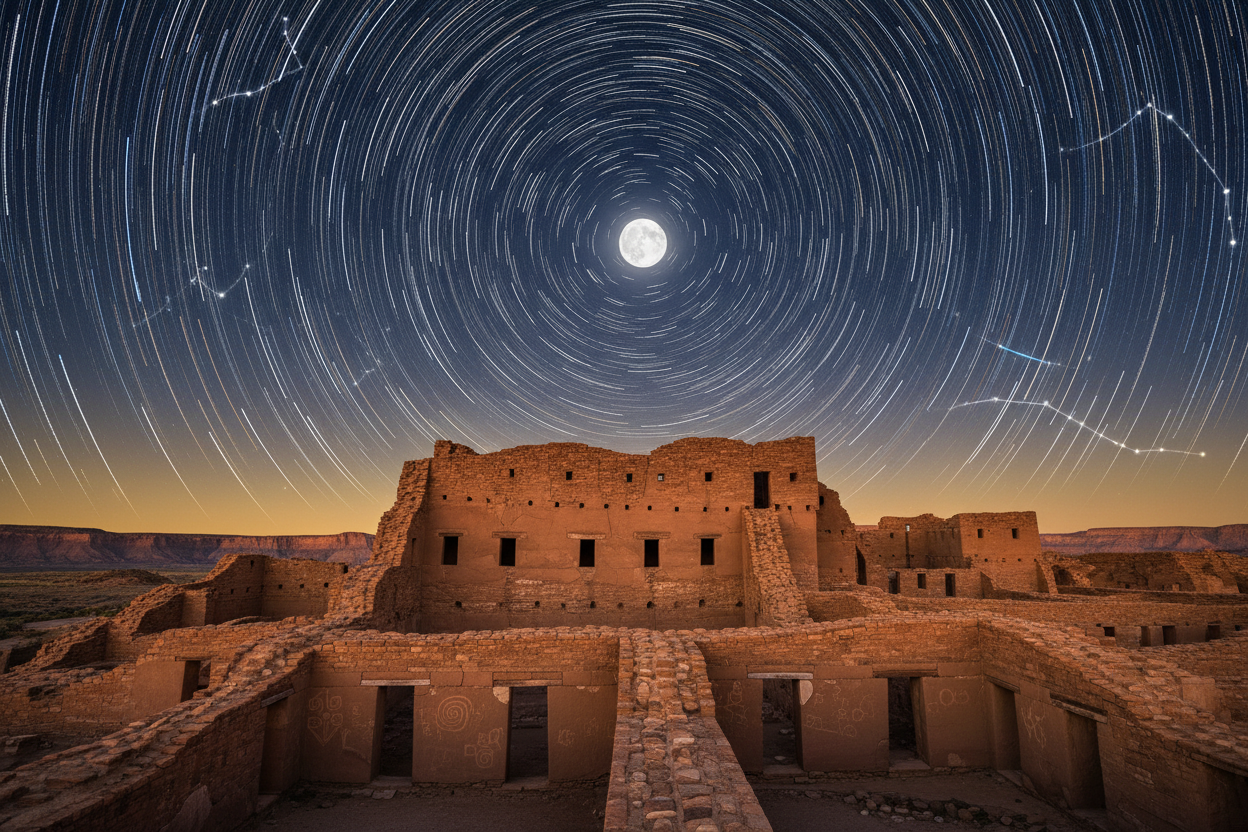
Deep in the high desert of northwestern New Mexico lies one of North America’s most remarkable archaeological treasures. Chaco Canyon, with its towering sandstone cliffs and mysterious ancient ruins, holds secrets that continue to astound researchers and visitors alike. Among the most fascinating discoveries at this UNESCO World Heritage site is the sophisticated astronomical knowledge of the Ancient Puebloans who called this place home over a thousand years ago.
The people who built the great houses and ceremonial structures of Chaco Canyon weren’t just skilled architects and engineers—they were accomplished astronomers who understood celestial movements with remarkable precision. Their ability to track the sun, moon, and stars influenced everything from their agricultural practices to their spiritual beliefs, leaving behind a legacy that challenges our assumptions about ancient civilizations.
The Ancient Puebloan Civilization at Chaco Canyon
Between 850 and 1150 CE, Chaco Canyon served as the cultural and ceremonial heart of the Ancient Puebloan world. This civilization, formerly known as the Anasazi, created a complex society that extended far beyond the canyon walls through an intricate network of roads connecting outlying communities across the Four Corners region.
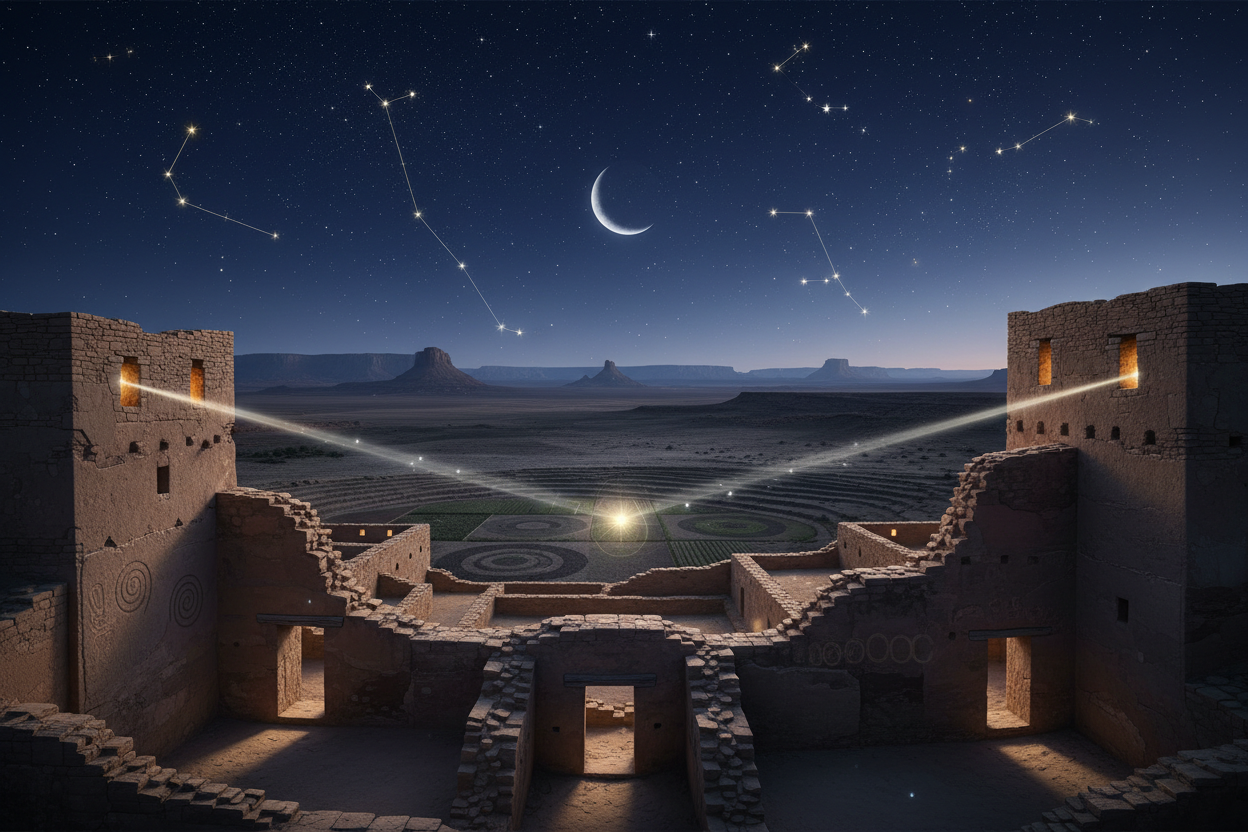
The inhabitants of Chaco Canyon constructed massive multi-story buildings called “great houses,” some containing hundreds of rooms. Pueblo Bonito, the largest of these structures, originally stood four stories tall and contained over 600 rooms. But these weren’t just impressive architectural achievements—they were carefully planned structures that incorporated sophisticated astronomical alignments.
What makes the Ancient Puebloans particularly remarkable is how they integrated their astronomical observations into daily life. Unlike modern societies where astronomy remains largely academic, these ancient people wove celestial knowledge into their architecture, agriculture, and spiritual practices in ways that demonstrate a deep understanding of cosmic cycles.
Astronomical Alignments in Chaco Architecture
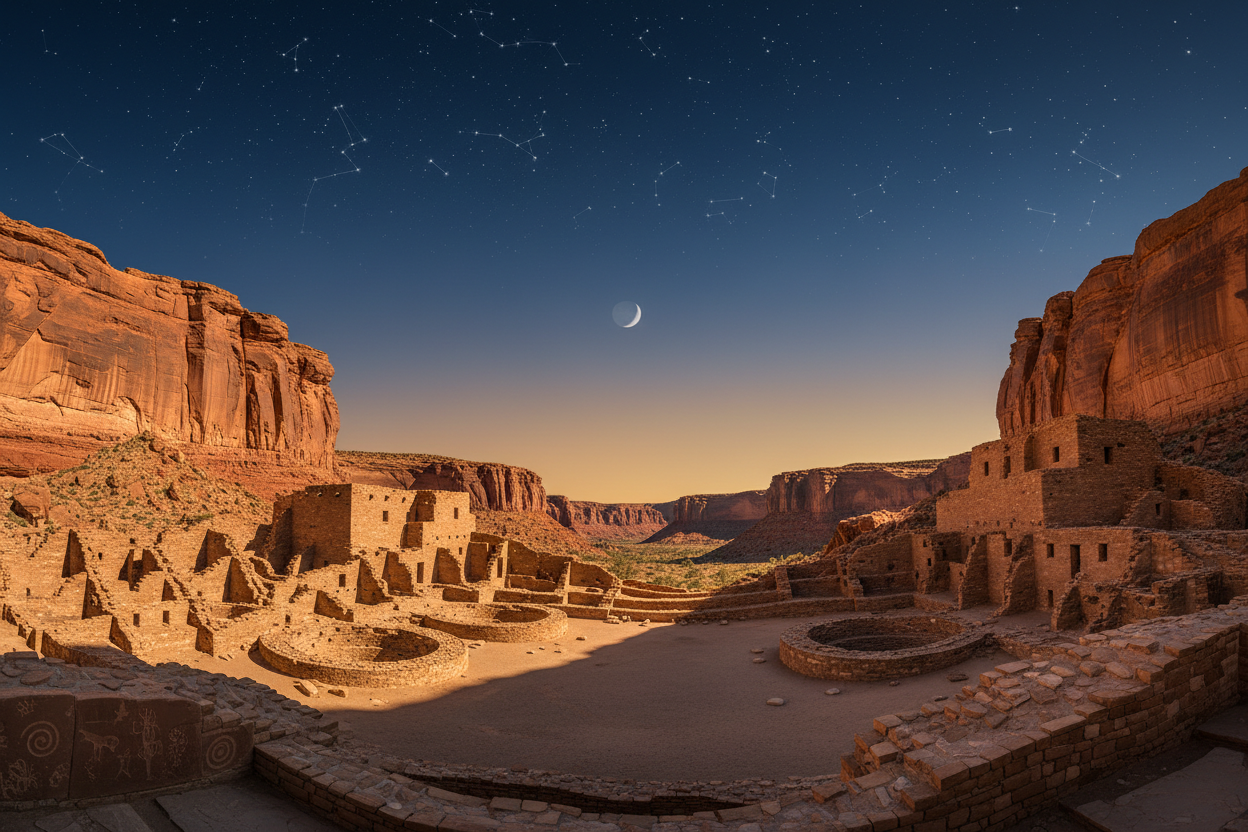
The great houses of Chaco Canyon reveal deliberate astronomical orientations that would have required generations of careful observation and planning. Researchers have identified numerous alignments that correspond to significant solar and lunar events, suggesting that the Ancient Puebloans designed their buildings as massive astronomical instruments.
Casa Rinconada, a great kiva (ceremonial chamber) at Chaco Canyon, provides one of the most striking examples of intentional astronomical alignment. This circular structure features 28 niches around its interior wall, which some researchers believe correspond to the lunar month. More dramatically, the kiva’s northeastern entrance aligns precisely with the summer solstice sunrise, allowing sunlight to flood the interior chamber on the longest day of the year.
Pueblo Bonito demonstrates equally impressive solar alignments. The building’s walls run almost perfectly north-south and east-west, and specific rooms and windows frame important solar events throughout the year. During the winter solstice, sunlight enters certain rooms in patterns that would have marked this crucial turning point in the annual cycle.
These alignments weren’t accidental. The precision required to achieve such astronomical orientations indicates that Ancient Puebloan architects possessed detailed knowledge of celestial mechanics and incorporated this understanding into their construction projects from the very beginning.
The Famous Sun Dagger Petroglyph
Perhaps no single discovery at Chaco Canyon captures the imagination quite like the Sun Dagger, a remarkable astronomical marker located atop Fajada Butte. This ingenious device demonstrates the sophisticated astronomical knowledge of the Ancient Puebloans in a way that continues to inspire wonder among modern visitors and researchers.
The Sun Dagger consists of three stone slabs that lean against a cliff face, creating narrow gaps that allow precise beams of sunlight to fall across two spiral petroglyphs carved into the rock behind them. Throughout the year, these light daggers move across the spirals in predictable patterns that mark important solar and lunar events.
During the summer solstice, a single shaft of light passes through the center of the larger spiral. At the winter solstice, two light beams frame the same spiral on either side. The spring and autumn equinoxes create their own distinctive patterns, with light daggers bisecting both spirals in specific ways.
What makes the Sun Dagger even more remarkable is its ability to track lunar cycles. The 18.6-year lunar standstill cycle, during which the moon reaches its maximum and minimum rising and setting positions, is precisely marked by the light patterns on the smaller spiral. This level of astronomical sophistication required decades of careful observation and represents one of the most accurate lunar calendars known from the ancient Americas.
Unfortunately, natural weathering and some human interference have affected the Sun Dagger’s precision in recent decades, making it less accurate than it was during the height of Chaco’s occupation. However, detailed documentation from the 1970s and 1980s preserves our understanding of this remarkable achievement.
Lunar Observations and the 18.6-Year Cycle
While solar observations might seem more obvious given the sun’s dramatic daily and seasonal changes, the Ancient Puebloans’ understanding of lunar cycles reveals an even deeper level of astronomical sophistication. The moon’s movements are more complex than the sun’s, requiring longer periods of observation and more nuanced understanding of celestial mechanics.
The 18.6-year lunar standstill cycle represents the moon’s most complex observable pattern. During this cycle, the moon’s rising and setting positions shift from their minimum range to their maximum range and back again. At lunar maximum, the moon rises and sets at its most extreme northern and southern positions on the horizon. At lunar minimum, these positions are much closer to the sun’s seasonal range.
Evidence suggests that the Ancient Puebloans not only understood this cycle but used it to time important ceremonial and construction activities. Some researchers propose that major building projects at Chaco Canyon were initiated or completed during specific phases of the lunar standstill cycle, indicating that these astronomical events held deep cultural and spiritual significance.
The ability to track such complex lunar patterns required institutional memory spanning multiple generations. Astronomical knowledge would have been carefully preserved and passed down through specialized groups within Chaco society, possibly including priest-astronomers who maintained this crucial information for the benefit of the entire community.
Agricultural Timing and Seasonal Calendars
In the high desert environment of Chaco Canyon, successful agriculture required precise timing. The growing season was short, water was scarce, and mistiming planting or harvesting could mean the difference between abundance and famine. The Ancient Puebloans’ astronomical knowledge provided them with accurate seasonal calendars that optimized their agricultural practices.
By tracking the sun’s position throughout the year, Chaco farmers could determine the optimal times for planting corn, beans, and squash—the “Three Sisters” crops that formed the foundation of their agricultural system. The spring equinox marked the beginning of the agricultural year, while the summer solstice indicated the peak growing season.
Lunar observations complemented solar tracking by providing more precise timing for specific agricultural activities. Certain phases of the moon were considered more favorable for planting, while others were associated with harvesting or processing crops. This lunar agricultural calendar allowed for fine-tuning that maximized crop yields in a challenging environment.
The astronomical alignments built into Chaco architecture served as permanent calendars that the entire community could reference. Rather than relying solely on the specialized knowledge of priest-astronomers, ordinary farmers could observe sunlight patterns in specific buildings to determine the appropriate timing for their agricultural activities.
Spiritual and Ceremonial Significance
For the Ancient Puebloans, astronomy wasn’t merely a practical tool for agriculture and timekeeping—it was deeply intertwined with their spiritual beliefs and ceremonial practices. The movements of celestial bodies were understood as expressions of sacred forces that influenced all aspects of life on Earth.
The great kivas at Chaco Canyon served as venues for ceremonies that connected earthly activities with celestial events. These circular chambers, often aligned with astronomical phenomena, provided sacred spaces where the community could gather during important solar and lunar events to perform rituals that maintained harmony between the human and cosmic worlds.
Solstices and equinoxes marked particularly significant ceremonial occasions. The winter solstice, representing the sun’s “death” and subsequent “rebirth,” was especially important in Ancient Puebloan cosmology. Ceremonies during this time focused on ensuring the sun’s return and the continuation of life-giving cycles.
The integration of astronomy into ceremonial architecture created powerful symbolic statements about the relationship between human society and the cosmos. By building their most important structures in alignment with celestial events, the Ancient Puebloans demonstrated their understanding of their place within a larger cosmic order and their responsibility to maintain harmony with natural cycles.
Modern Archaeological Discoveries
Contemporary archaeological research continues to reveal new aspects of Ancient Puebloan astronomical knowledge. Advanced surveying techniques, computer modeling, and interdisciplinary collaboration between archaeologists, astronomers, and anthropologists have deepened our understanding of Chaco Canyon’s astronomical significance.
Recent studies have identified previously unknown astronomical alignments in Chaco architecture. High-precision GPS mapping and 3D modeling have revealed subtle orientations that earlier researchers missed, suggesting that astronomical considerations influenced building design even more extensively than previously recognized.
Researchers have also expanded their investigations beyond Chaco Canyon proper to examine astronomical alignments in the broader Chaco regional system. Outlying great houses and ceremonial sites throughout the Four Corners region show similar astronomical orientations, indicating that this knowledge was shared across the entire Ancient Puebloan cultural network.
Collaboration with modern Pueblo communities has provided valuable insights into the cultural context of ancient astronomical practices. Contemporary Pueblo peoples maintain astronomical traditions that can be traced back to their Chaco ancestors, offering perspectives on the spiritual and practical significance of celestial observations that purely archaeological evidence cannot provide.
Preservation and Ongoing Research
Protecting Chaco Canyon’s astronomical heritage presents unique challenges. Unlike portable artifacts that can be moved to climate-controlled museums, astronomical alignments are fixed in place and vulnerable to natural weathering, vandalism, and inadvertent damage from increased visitation.
The National Park Service works diligently to preserve Chaco’s astronomical sites while making them accessible to researchers and the public. This includes monitoring the condition of astronomical markers like the Sun Dagger, documenting alignments before they’re lost to erosion, and educating visitors about the importance of these fragile resources.
Ongoing research projects continue to expand our knowledge of Ancient Puebloan astronomy. New technologies, including ground-penetrating radar and satellite imagery analysis, are revealing previously unknown aspects of Chaco’s astronomical landscape. These discoveries ensure that our understanding of this remarkable civilization continues to evolve.
The preservation of Chaco Canyon’s astronomical heritage also depends on maintaining the dark skies that made ancient observations possible. Light pollution from distant cities increasingly threatens the night sky visibility that allowed the Ancient Puebloans to make their precise celestial observations, making dark sky preservation an important conservation priority.
The astronomical achievements of the Ancient Puebloans at Chaco Canyon represent one of humanity’s most remarkable examples of indigenous scientific knowledge. Their ability to integrate sophisticated celestial observations into architecture, agriculture, and spiritual practice created a harmonious relationship between human society and the cosmos that continues to inspire us today. As we face our own challenges in understanding our place in the universe, the wisdom of Chaco Canyon reminds us that astronomy has always been fundamentally about connecting human life to the greater rhythms of the natural world.
Frequently Asked Questions
How accurate were the Ancient Puebloans’ astronomical observations?
The Ancient Puebloans achieved remarkable accuracy in their astronomical observations, with some alignments precise to within fractions of a degree. Their tracking of the 18.6-year lunar cycle and solar events demonstrates observational skills comparable to many ancient civilizations worldwide.
Can visitors see the Sun Dagger phenomenon today?
Access to the Sun Dagger site on Fajada Butte is currently restricted to protect this fragile archaeological resource. However, the National Park Service occasionally offers special guided tours, and visitors can learn about the Sun Dagger through interpretive programs and exhibits at the visitor center.
What tools did the Ancient Puebloans use for astronomical observations?
The Ancient Puebloans relied primarily on careful naked-eye observations and used natural and constructed landmarks as reference points. They incorporated astronomical alignments directly into their architecture, essentially turning their buildings into large-scale astronomical instruments.
How do we know the astronomical alignments were intentional?
The precision and consistency of astronomical alignments across multiple structures at Chaco Canyon, combined with the sophisticated understanding of complex celestial cycles like the lunar standstill, provide strong evidence that these orientations were deliberate rather than coincidental.
Are there other sites with similar astronomical features?
Yes, astronomical alignments have been found at Ancient Puebloan sites throughout the Southwest, as well as at other indigenous sites across North and South America. However, Chaco Canyon represents one of the most comprehensive and sophisticated examples of ancient astronomical knowledge in the Americas.