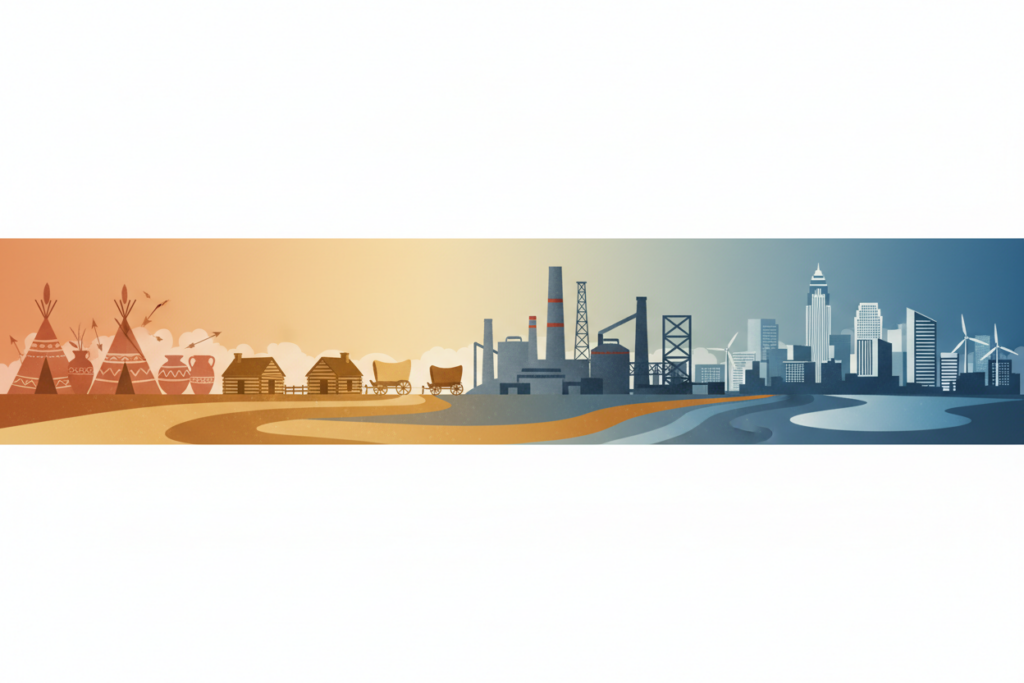
Ohio’s story reads like an epic novel, filled with ancient civilizations, frontier adventures, industrial triumphs, and modern innovations. Nestled in the heart of the Midwest, the Buckeye State has served as a crossroads of American history for thousands of years. From the sophisticated mound-building cultures that flourished along its rivers to the bustling cities that drive today’s economy, Ohio’s rich heritage continues to shape not only the state itself but the entire nation.
Whether you’re a history enthusiast, an Ohio resident curious about your state’s past, or simply someone fascinated by American heritage, this journey through Ohio’s timeline will reveal surprising connections, forgotten stories, and lasting legacies that still influence our world today.
The First Ohioans: Native American Civilizations
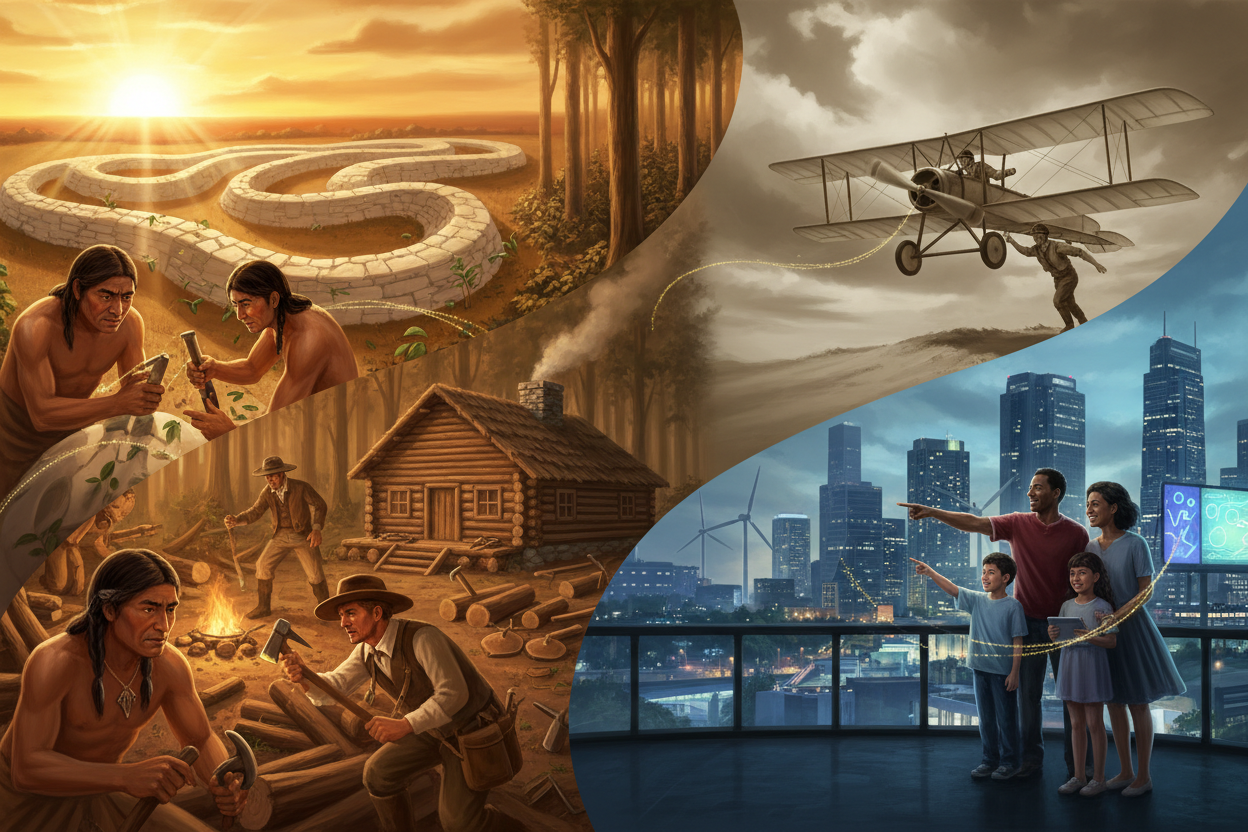
Long before European explorers set foot on Ohio soil, sophisticated Native American civilizations called this land home. The earliest evidence of human habitation dates back over 13,000 years, when Paleo-Indian hunters pursued massive ice-age mammals across the landscape.
Perhaps the most remarkable of Ohio’s ancient peoples were the Adena culture (800 BCE – 100 CE) and their successors, the Hopewell culture (100 BCE – 500 CE). These weren’t simple hunter-gatherer societies – they were complex civilizations that created some of North America’s most impressive archaeological wonders.
The Hopewell people, in particular, established extensive trade networks that stretched from the Rocky Mountains to the Atlantic Ocean. Archaeologists have discovered obsidian from Yellowstone, copper from the Great Lakes, and shells from the Gulf of Mexico in Ohio burial mounds, proving these ancient Ohioans were sophisticated traders and cultural ambassadors.
The crown jewel of this prehistoric legacy is Serpent Mound in Adams County. This quarter-mile-long earthwork, shaped like a massive serpent, continues to mystify researchers and visitors alike. Standing beside this ancient monument, you can’t help but feel connected to the skilled engineers and astronomers who created it over a thousand years ago.
By the time European explorers arrived, several Native American tribes inhabited Ohio, including the Shawnee, Miami, Wyandot, and Delaware peoples. These groups had developed rich cultural traditions, sophisticated agricultural practices, and complex political alliances that would soon face unprecedented challenges.
European Exploration and Colonial Struggles
Ohio’s European chapter began in the late 1600s when French explorers like René-Robert Cavelier, Sieur de La Salle, ventured into the Ohio River Valley. The French saw this territory as a crucial link in their North American empire, connecting their settlements in Canada with those along the Mississippi River.
However, the British had different plans. As their colonies along the Atlantic coast grew and prospered, land-hungry settlers looked westward to Ohio’s fertile valleys and abundant forests. This competing vision set the stage for the French and Indian War (1754-1763), a conflict that would determine Ohio’s future.
The war’s outcome placed Ohio under British control, but this victory proved short-lived. British policies restricting westward expansion frustrated American colonists, and Ohio became a symbol of the opportunities that lay beyond the Appalachian Mountains. When the American Revolution erupted, control of Ohio represented more than just territory – it embodied the promise of American expansion and opportunity.
During the Revolutionary War, Ohio became a bloody battleground between American forces, British troops, and their Native American allies. The conflict devastated Native American communities and opened the door for massive American settlement that would follow.
Statehood and the Northwest Territory Era
After winning independence, the new United States faced a crucial question: how should western territories be organized and governed? Ohio became the testing ground for American expansion policies through the Northwest Ordinance of 1787, one of the most important pieces of legislation in American history.
This groundbreaking law established principles that would guide American expansion for generations. It prohibited slavery in the Northwest Territory, guaranteed religious freedom, and promised eventual statehood for territories that met specific population requirements. These weren’t just abstract legal concepts – they shaped the character of Ohio and every state that followed.
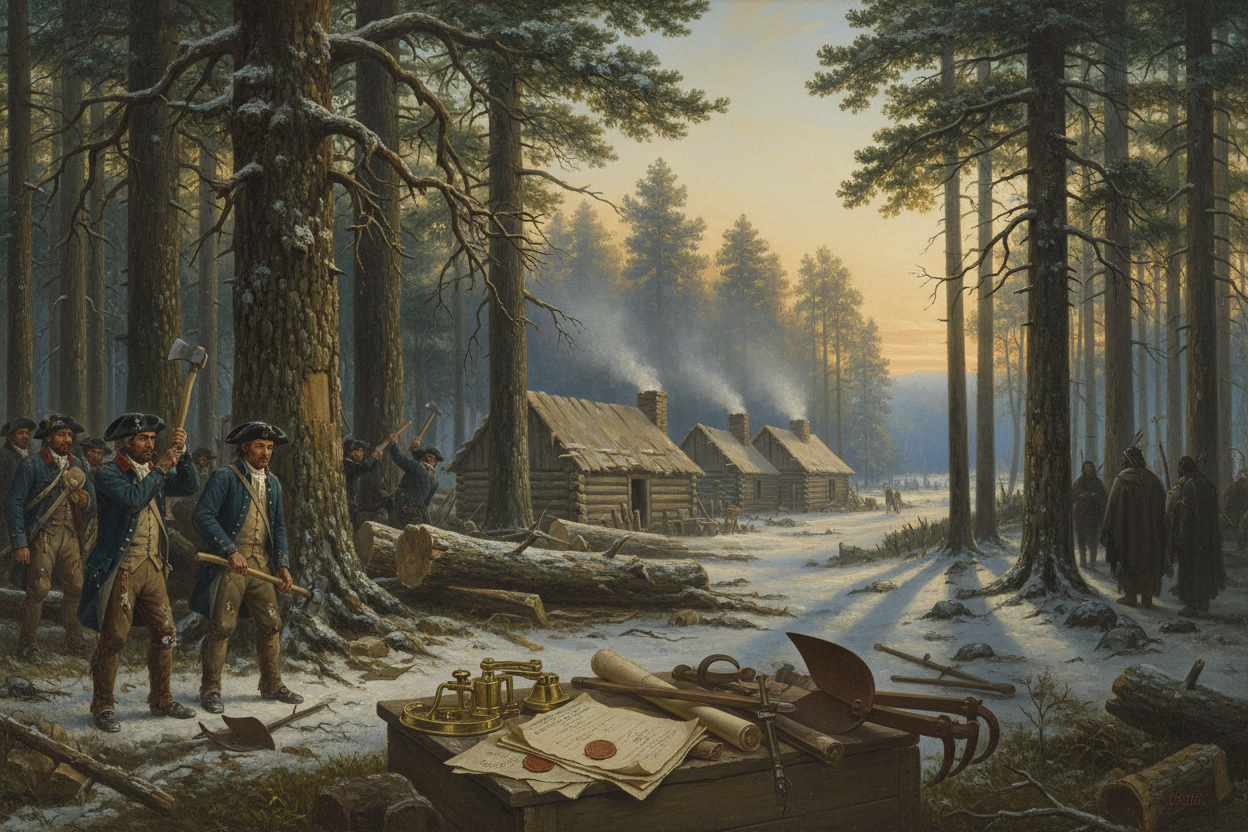
The Ohio Company of Associates, led by Revolutionary War veterans, established Marietta in 1788 as Ohio’s first permanent settlement. These early pioneers faced incredible hardships: harsh winters, conflicts with Native Americans, and the constant challenge of carving civilization from wilderness. Yet they persevered, driven by the promise of land ownership and opportunity that Ohio represented.
On March 1, 1803, Ohio achieved statehood, becoming the first state carved from the Northwest Territory. This milestone represented more than just political recognition – it proved that the American experiment in democratic expansion could work.
The Industrial Revolution Transforms Ohio
Ohio’s location proved perfect for the Industrial Revolution that swept America in the 19th century. The state’s abundant natural resources, strategic position between East and West, and access to water transportation made it an industrial powerhouse.
The completion of the Ohio and Erie Canal in 1832 transformed the state’s economy overnight. This engineering marvel connected Lake Erie with the Ohio River, allowing goods to flow efficiently between the Great Lakes and the Mississippi River system. Cities like Cleveland, Akron, and Columbus exploded in size as commerce flowed through their streets.
But it was Ohio’s role in America’s transportation revolution that truly set it apart. The state became a crucial hub for the expanding railroad network, with cities like Cincinnati emerging as major railroad centers. By the 1850s, you could travel from New York to St. Louis through Ohio, connecting the nation’s growing regions.
Ohio’s industrial growth accelerated during the Civil War, as the state’s factories produced weapons, uniforms, and supplies for the Union Army. This wartime production established Ohio as a manufacturing center, a reputation that would define the state for generations.
The discovery of oil in Ohio during the 1880s added another dimension to the state’s industrial profile. John D. Rockefeller built his Standard Oil empire from Cleveland, creating one of America’s first major corporations and establishing Ohio as a center of business innovation.
Ohio’s Pivotal Role in the Civil War
When the Civil War erupted in 1861, Ohio stood firmly with the Union, but the state’s contribution went far beyond simple allegiance. Ohio provided over 300,000 soldiers to the Union cause – more than any other Northern state except New York and Pennsylvania.
The state produced some of the war’s most important military leaders, including Ulysses S. Grant, William Tecumseh Sherman, and Philip Sheridan. These Ohio-born generals didn’t just fight battles – they developed the strategies that ultimately won the war for the Union.
Ohio’s location made it a crucial stop on the Underground Railroad, the secret network that helped enslaved people escape to freedom. Cities like Oberlin became centers of abolitionist activity, while ordinary Ohioans risked their lives to help freedom seekers reach safety in Canada.
The war’s impact on Ohio extended beyond the battlefield. The state’s industries boomed as they supplied the Union war effort, while Ohio farmers fed both the army and the growing industrial workforce. This wartime experience transformed Ohio from a primarily agricultural state into an industrial powerhouse.
The Rise of Industrial Powerhouses
The late 19th and early 20th centuries marked Ohio’s golden age of industrial innovation. The state became synonymous with American manufacturing prowess, producing everything from steel and rubber to automobiles and aircraft.
Cleveland emerged as a steel-making giant, its mills feeding America’s growing appetite for infrastructure and industrial goods. The city’s location on Lake Erie provided easy access to iron ore from Minnesota’s Mesabi Range, while coal from Pennsylvania and West Virginia fueled the furnaces that forged America’s industrial backbone.
Akron earned the nickname “Rubber Capital of the World” as companies like Goodyear, Firestone, and Goodrich established their headquarters there. These companies didn’t just make tires – they pioneered manufacturing techniques and labor practices that influenced industries nationwide.
Perhaps most significantly, Ohio became the birthplace of aviation. Wilbur and Orville Wright, bicycle mechanics from Dayton, achieved powered flight in 1903 at Kitty Hawk, North Carolina. But they developed their flying machine in Ohio, and Dayton remains a center of aerospace innovation to this day.
The automotive industry also found a home in Ohio, with cities like Toledo and Youngstown becoming major centers of auto production. These weren’t just factories – they were symbols of American innovation and the promise of upward mobility for working families.
Modern Ohio: Innovation and Transformation
The latter half of the 20th century brought both challenges and opportunities to Ohio. The decline of heavy manufacturing, often called “deindustrialization,” hit Ohio particularly hard during the 1970s and 1980s. Steel mills closed, rubber plants moved overseas, and entire communities faced economic devastation.
However, Ohio’s response to these challenges demonstrated the same resilience that had characterized the state throughout its history. Instead of simply mourning lost industries, Ohioans embraced innovation and diversification.
Cleveland transformed itself from a rust belt casualty into a healthcare and biotechnology hub. The Cleveland Clinic became a world-renowned medical center, while Case Western Reserve University emerged as a leader in research and innovation.
Columbus leveraged its position as the state capital and home to Ohio State University to become a center of education, government, and technology. The city’s diverse economy proved remarkably resilient during economic downturns.
Cincinnati reinvented itself as a corporate headquarters city, hosting major companies like Procter & Gamble, Kroger, and Fifth Third Bank. The city’s location on the Ohio River, once crucial for 19th-century commerce, proved valuable again as companies sought strategic locations for distribution and logistics.
Ohio’s Cultural and Political Legacy
Ohio’s influence extends far beyond industry and economics. The state has produced more U.S. presidents than any other except Virginia – eight in total, earning it the nickname “Mother of Presidents.” From William Henry Harrison to Warren G. Harding, Ohio-born presidents shaped American policy during crucial periods of national development.
The state’s cultural contributions are equally impressive. Ohio gave America aviation pioneers, industrial innovators, and cultural icons. From Thomas Edison (though born elsewhere, he spent crucial years in Ohio) to Steven Spielberg, LeBron James to Toni Morrison, Ohio has consistently produced individuals who’ve shaped American culture.
Ohio’s commitment to education has been a constant throughout its history. The state was among the first to establish public education systems, and Ohio universities like Oberlin College pioneered coeducation and racial integration. Today, institutions like Ohio State University, Case Western Reserve University, and Oberlin College continue this tradition of educational innovation.
Politically, Ohio has earned recognition as the ultimate swing state, often determining presidential elections. This political influence reflects Ohio’s position as a microcosm of America – urban and rural, industrial and agricultural, conservative and liberal. Understanding Ohio often means understanding America itself.
Conclusion: Ohio’s Enduring Legacy
From the sophisticated earthworks of the Hopewell culture to the cutting-edge research laboratories of today, Ohio’s history reveals a consistent pattern of innovation, resilience, and adaptation. The state that began as a testing ground for American expansion has become a laboratory for American renewal.
Ohio’s story reminds us that history isn’t just about dates and names – it’s about people facing challenges, embracing opportunities, and building better futures for their children. The Native Americans who created Serpent Mound, the pioneers who carved farms from wilderness, the inventors who gave us flight, and the modern Ohioans who are building tomorrow’s economy all share this common thread.
As Ohio continues to evolve in the 21st century, its rich history provides both inspiration and guidance. The same spirit that drove ancient traders to build continental networks, that motivated Underground Railroad conductors to risk everything for freedom, and that inspired two bicycle mechanics to believe they could fly, continues to drive Ohio forward.
Understanding Ohio’s fascinating history helps us appreciate not just where we’ve been, but where we’re going. In a state that has consistently served as a bridge between America’s past and future, that journey promises to be just as remarkable as the one that brought us here.