
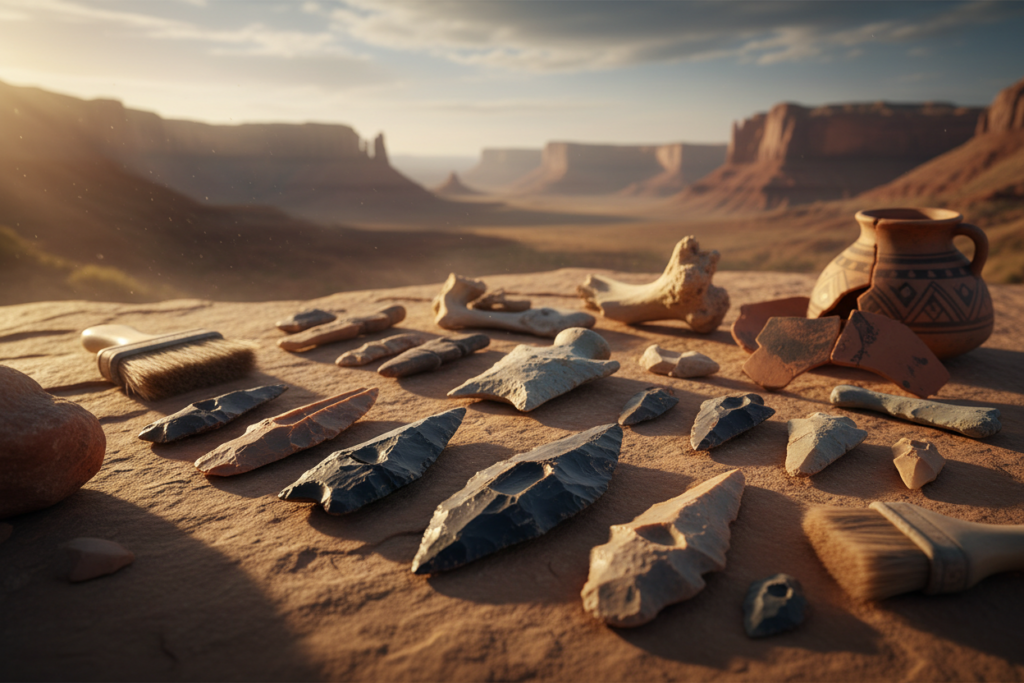
Deep beneath the windswept plains of New Mexico, archaeologists made a discovery that would forever change our understanding of human history in North America. In 1929, near the town of Clovis, they unearthed distinctive stone spear points alongside the bones of extinct mammoths, providing the first concrete evidence of ancient peoples who lived on this continent over 13,000 years ago. These remarkable findings introduced the world to what we now call the Clovis culture, widely considered to represent some of America’s earliest inhabitants.
The story of the Clovis people isn’t just about ancient artifacts gathering dust in museum cases. It’s a fascinating glimpse into the lives of skilled hunters and toolmakers who survived in a world vastly different from our own, where massive ice sheets stretched across much of North America and giant creatures roamed the landscape. Their legacy, preserved in stone and bone, continues to captivate researchers and rewrite the narrative of human migration to the Americas.
Who Were the Clovis Culture Paleo Indians?
The Clovis culture represents a distinctive archaeological tradition that flourished across North America between approximately 13,500 and 12,800 years ago. Named after the type site near Clovis, New Mexico, these Paleo Indians were sophisticated hunter-gatherers who developed one of the most recognizable stone tool technologies in North American prehistory.
What makes the Clovis people particularly intriguing is their rapid spread across the continent. Archaeological evidence suggests they dispersed from Alaska to Central America in just a few centuries, an remarkably swift colonization that speaks to their adaptability and resourcefulness. These weren’t simply wandering nomads, but organized groups with advanced knowledge of toolmaking, hunting strategies, and survival techniques perfectly suited to the challenging environment of late Pleistocene America.
The Clovis people lived during the waning days of the last Ice Age, when North America looked dramatically different than it does today. Massive glacial ice sheets covered much of Canada and the northern United States, while the climate was generally cooler and drier. This environment supported vast grasslands that sustained enormous herds of now-extinct megafauna, including mammoths, mastodons, giant ground sloths, and saber-toothed cats.
The Discovery That Changed Everything: Blackwater Draw
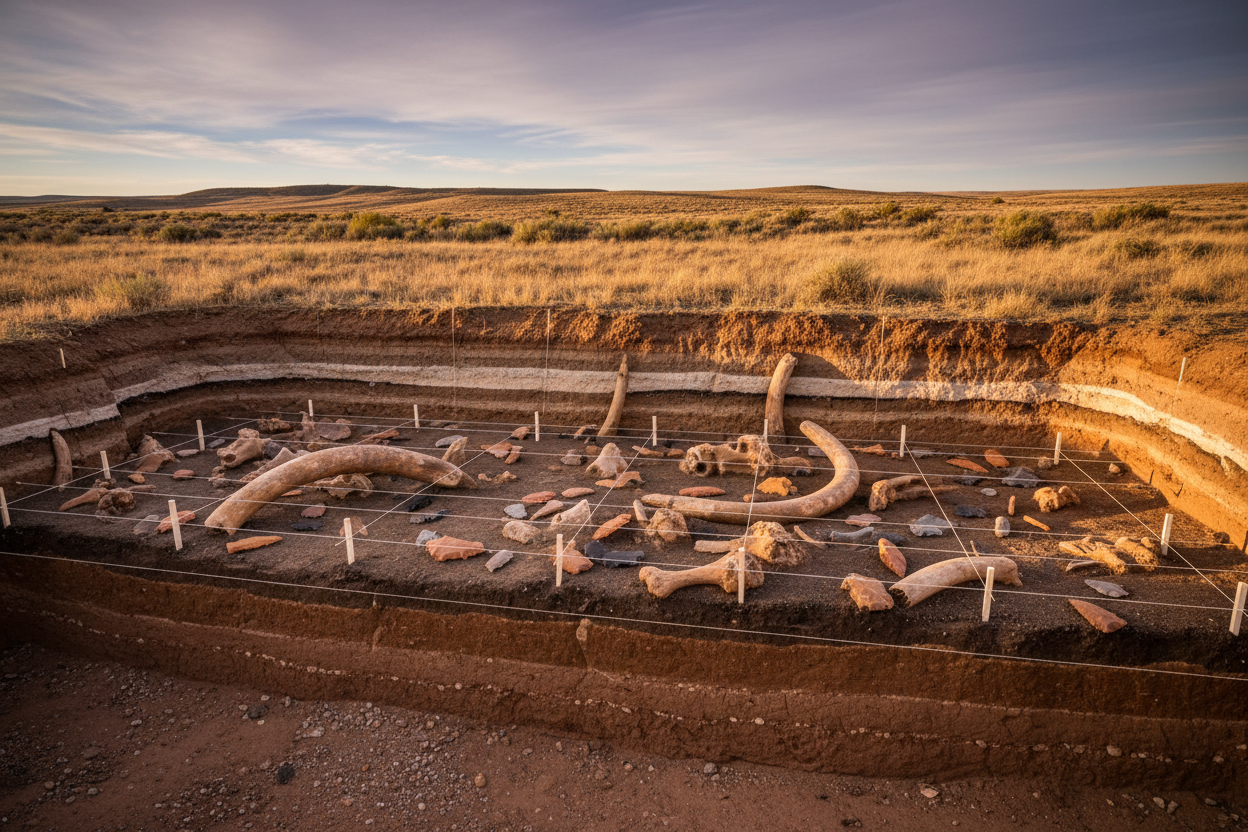
The breakthrough moment in Clovis archaeology came at a site called Blackwater Draw, located near Clovis, New Mexico. In 1929, a teenager named Ridgely Whiteman discovered large animal bones eroding from an arroyo wall. Word of the discovery reached Edgar Howard, an archaeologist from the University of Pennsylvania, who began systematic excavations at the site in 1932.
What Howard and his team uncovered was nothing short of revolutionary. They found distinctive stone spear points in direct association with the bones of extinct Pleistocene animals, particularly Columbian mammoths. This was the first undisputable evidence that humans had lived in North America during the Ice Age, settling a long-standing debate in American archaeology about the antiquity of human occupation in the New World.
The Blackwater Draw site became the type site for Clovis culture, establishing the standard by which similar discoveries across North America would be measured. The meticulous excavation methods employed at the site set new standards for archaeological fieldwork and helped establish the credibility of Paleo Indian research as a legitimate scientific discipline.
Distinctive Clovis Stone Tool Technology
Perhaps nothing defines the Clovis culture more than their distinctive stone projectile points. These beautifully crafted tools are instantly recognizable to archaeologists and represent one of the most sophisticated stone-working traditions ever developed in prehistoric North America.
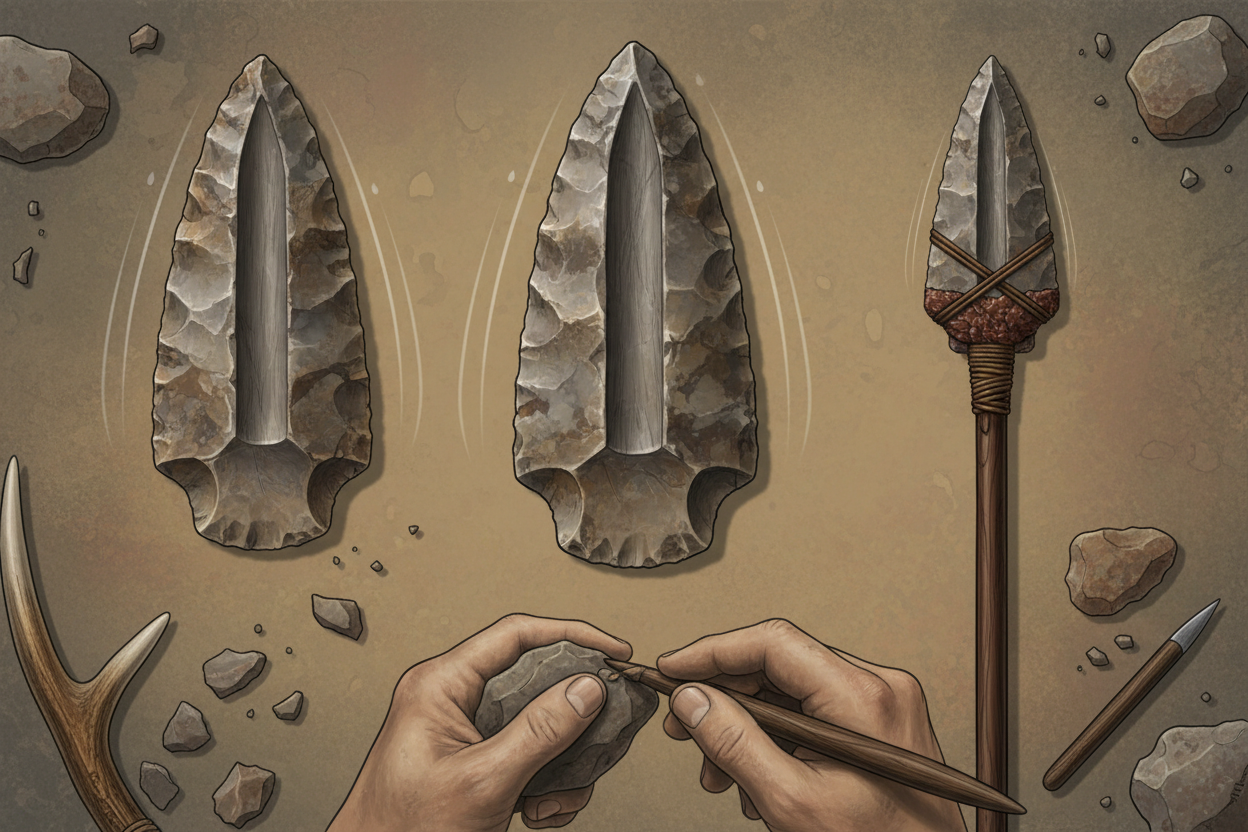
Clovis points are characterized by their distinctive fluting, a technique where toolmakers removed long, thin flakes from the base of the point on both faces. This fluting served multiple purposes: it thinned the base for easier hafting to wooden spear shafts, created sharp edges for cutting, and may have improved the point’s aerodynamic properties. The skill required to produce these fluted points was considerable, as the fluting process could easily ruin hours of careful work if done incorrectly.
Beyond projectile points, Clovis toolmakers produced a sophisticated array of implements including scrapers, knives, gravers, and choppers. They showed a remarkable ability to work with various types of stone, often traveling considerable distances to obtain high-quality materials like chert, obsidian, and chalcedony. This suggests they possessed extensive knowledge of regional geology and maintained trade networks or seasonal rounds that allowed access to superior toolstone sources.
The technological sophistication of Clovis tools extends beyond their functional aspects. Many points display a level of craftsmanship that goes beyond mere utility, suggesting that toolmaking held cultural significance beyond simple practicality. Some researchers believe that the standardized nature of Clovis point technology across vast geographical distances indicates shared cultural traditions and possibly even specialized toolmakers within Clovis society.
Hunting Strategies and Megafauna Extinction
The Clovis people were skilled big-game hunters who specialized in pursuing North America’s Pleistocene megafauna. Archaeological evidence from kill sites across the continent reveals that they successfully hunted mammoths, mastodons, giant bison, horses, and camels. Their hunting prowess is particularly evident at sites like Murray Springs in Arizona and the Lange-Ferguson site in South Dakota, where researchers have found evidence of organized hunting activities.
Clovis hunting strategies appear to have been sophisticated and well-planned. Evidence suggests they often targeted young or weakened animals, used natural landscape features to their advantage, and employed cooperative hunting techniques that required coordination among multiple individuals. At some sites, archaeologists have found evidence of processing areas where large animals were systematically butchered and their resources distributed among the group.
The relationship between Clovis hunters and megafauna extinction remains one of the most debated topics in American archaeology. Many of North America’s large Pleistocene animals went extinct around the same time that Clovis people appeared on the landscape, leading some researchers to propose that human hunting pressure contributed to these extinctions. This “overkill hypothesis” suggests that Clovis hunters, as efficient predators new to the American landscape, may have driven vulnerable species to extinction.
However, the relationship between human arrival and megafauna extinction is likely more complex than simple overhunting. Climate change at the end of the Pleistocene was dramatically altering habitats across North America, and the combination of environmental stress and human hunting pressure probably created a perfect storm for extinction. Recent research suggests that Clovis people were actually quite selective in their hunting, focusing on certain species while largely ignoring others that also went extinct.
Archaeological Sites Across North America
Clovis sites have been discovered across North America, from Alaska to Central America, demonstrating the remarkable geographic extent of this cultural tradition. Each site contributes unique insights into Clovis lifeways and helps archaeologists piece together the complex story of early human adaptation in the Americas.
Some of the most significant Clovis sites include the Gault site in Texas, which has yielded thousands of artifacts and provided insights into Clovis toolmaking techniques and daily life activities. The Anzick site in Montana gained international attention when the burial of a Clovis-age infant was discovered along with numerous artifacts, providing the first ancient DNA evidence from a Clovis individual.
The Wenzel site in Colorado offers evidence of Clovis bison hunting, while sites like Kimmswick in Missouri demonstrate mammoth hunting activities. Each of these locations adds pieces to the puzzle of understanding how Clovis people adapted to different environments and resources across the diverse landscape of Ice Age North America.
What’s particularly striking about Clovis sites is their consistency across vast distances. Despite being separated by thousands of miles, Clovis assemblages show remarkable similarity in tool types, manufacturing techniques, and even stylistic details. This suggests either rapid cultural transmission across the continent or possibly a single population that spread quickly across the landscape while maintaining strong cultural connections.
Dating Methods and Timeline
Establishing accurate dates for Clovis sites has been crucial for understanding the timing of human arrival in the Americas and the relationship between human colonization and environmental changes. Archaeologists employ multiple dating techniques to build reliable chronologies for Clovis occupations.
Radiocarbon dating remains the primary method for dating Clovis sites, with most reliable dates falling between 13,500 and 12,800 years ago. However, obtaining accurate dates can be challenging due to contamination issues, the association between dated materials and cultural deposits, and the limitations of radiocarbon dating itself. Recent advances in radiocarbon dating techniques, including improved pretreatment methods and accelerator mass spectrometry, have helped refine Clovis chronology.
The relatively short duration of the Clovis culture, spanning only about 700 years, raises interesting questions about what happened to these people and their distinctive technology. Some researchers suggest that Clovis culture evolved into later Paleo Indian traditions, while others propose that environmental changes at the end of the Pleistocene forced cultural adaptations that resulted in new technological traditions.
Recent Discoveries and Ongoing Research
Clovis archaeology continues to evolve as new discoveries and analytical techniques provide fresh insights into these ancient peoples. Recent excavations at sites like Blackwater Draw continue to yield new information, while advances in scientific analysis allow researchers to extract more detailed information from previously excavated materials.
One of the most exciting recent developments has been the application of ancient DNA analysis to Clovis remains. The Anzick burial has provided genetic evidence linking Clovis people to modern Native American populations, supporting the idea that contemporary indigenous peoples are descendants of these early inhabitants. This genetic evidence has helped resolve long-standing questions about the relationship between Paleo Indians and later Native American groups.
Advances in lithic analysis, including use-wear studies and residue analysis, are providing new insights into how Clovis tools were used and what materials they processed. These techniques are revealing that Clovis technology was even more sophisticated than previously thought, with specialized tools for processing plant materials, working wood and bone, and performing detailed tasks beyond simple hunting activities.
Experimental archaeology has also contributed significantly to our understanding of Clovis technology. Modern flint knappers have recreated Clovis points and tested their effectiveness, providing insights into the skill levels required for their manufacture and their performance characteristics as hunting weapons. These experiments have revealed that Clovis points were remarkably effective tools, well-suited for the hunting tasks they were designed to perform.
Frequently Asked Questions
How old is the Clovis culture?
The Clovis culture dates to approximately 13,500 to 12,800 years ago, during the late Pleistocene period. This timeframe is based on radiocarbon dating of organic materials found in association with Clovis artifacts at sites across North America.
Were the Clovis people really the first Americans?
While Clovis people were among the earliest well-documented inhabitants of North America, growing evidence suggests that other groups may have arrived earlier. Pre-Clovis sites like Monte Verde in Chile and possibly Meadowcroft in Pennsylvania indicate human presence in the Americas before Clovis times, though these earlier occupations remain subjects of ongoing research and debate.
What happened to the Clovis culture?
The Clovis culture appears to have ended around 12,800 years ago, coinciding with significant environmental changes at the end of the Pleistocene. Rather than disappearing entirely, Clovis people likely adapted to changing conditions and evolved into later Paleo Indian cultures with different technological traditions.
How did Clovis people make their distinctive fluted points?
Clovis points were made through a sophisticated stone-knapping process that involved careful preparation of the stone core, removal of flakes to shape the point, and finally the removal of channel flakes to create the characteristic fluting. This process required considerable skill and experience, as mistakes could ruin hours of work.
Did Clovis people only hunt large animals?
While Clovis people are famous for hunting megafauna like mammoths and mastodons, archaeological evidence suggests they had a more diverse diet that included smaller animals, fish, and plant resources. Their toolkit included implements for processing various types of food resources beyond just large game animals.
How widespread was Clovis culture?
Clovis sites have been found from Alaska to Central America, making it one of the most geographically extensive archaeological cultures in North American prehistory. This wide distribution occurred in a relatively short time period, suggesting rapid population expansion and cultural transmission across the continent.
The legacy of the Clovis culture extends far beyond their archaeological remains. These skilled hunter-gatherers represent a crucial chapter in human history, demonstrating the remarkable adaptability and ingenuity of our species. Their successful colonization of a new continent during challenging environmental conditions speaks to the resourcefulness that has characterized human expansion throughout our evolutionary history. As research continues and new discoveries emerge, the Clovis people continue to inform our understanding of early American history and the complex story of human migration to the New World. Their distinctive tools and hunting sites serve as windows into a vanished world, reminding us of the deep roots of human presence in the Americas and the sophisticated cultures that flourished here thousands of years before European contact.