Step into a world where centuries of history unfold beneath your feet with every stride. Santa Fe, New Mexico, proudly holds the distinction of being America’s oldest state capital, and nowhere is this rich heritage more palpable than in its historic plazas. These ancient gathering places have witnessed the rise and fall of empires, the blending of cultures, and the evolution of the American Southwest. Join us on an enchanting walking tour through Santa Fe’s most significant plazas, where Spanish colonial architecture meets Native American traditions, and every corner tells a story that spans over 400 years.
The Heart of Santa Fe: Plaza de Armas (The Plaza)
Your journey begins at the crown jewel of Santa Fe’s historic district – the Plaza, officially known as Plaza de Armas. Established in 1610, this central square has served as the beating heart of the city for more than four centuries. As you stand in this rectangular space, measuring approximately 120 by 240 feet, you’re occupying the same ground where Spanish conquistadors, Mexican traders, and American pioneers once gathered.
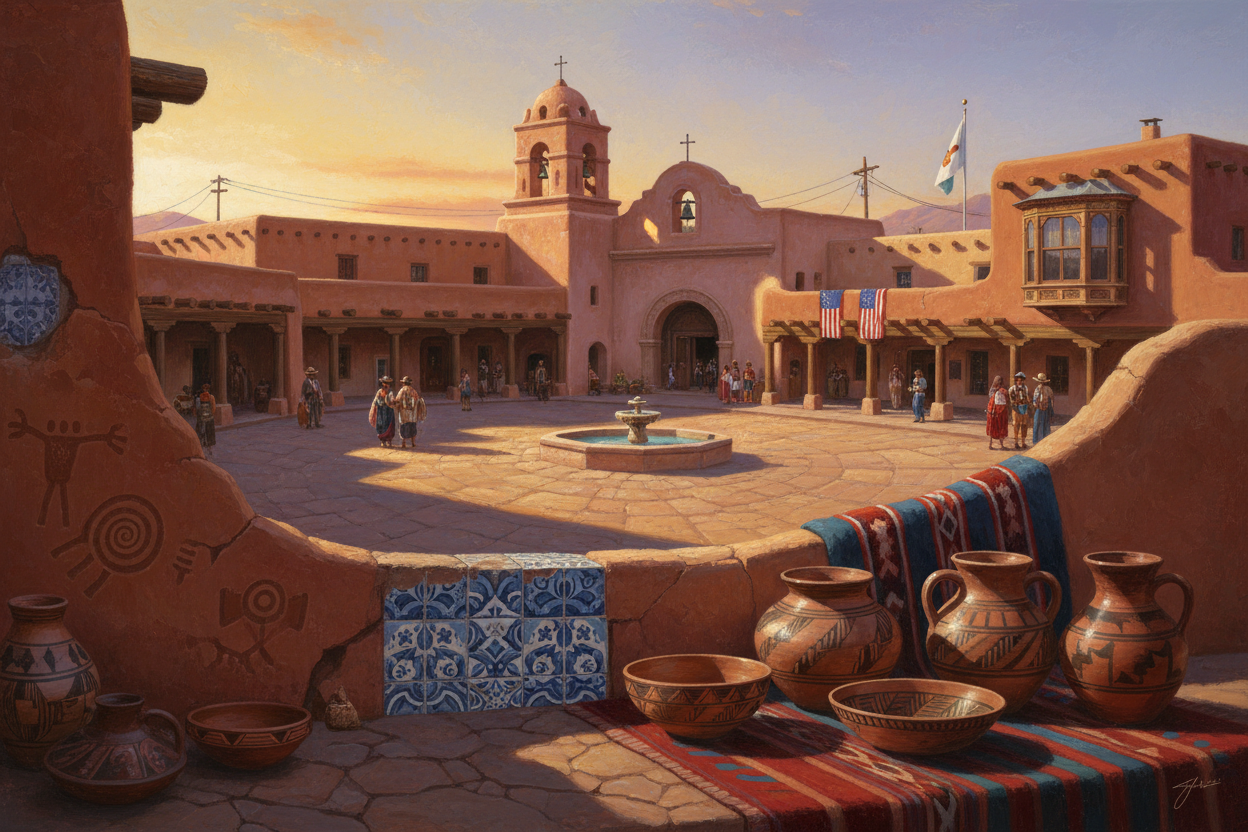
The Plaza’s design follows the traditional Spanish colonial town planning principles outlined in the Laws of the Indies. Notice how the surrounding buildings create a protective embrace around the central space, with their characteristic adobe walls and vigas (wooden beams) extending from the structures. The Palace of the Governors, which forms the Plaza’s northern boundary, stands as the oldest continuously occupied public building in the United States, dating back to 1610.
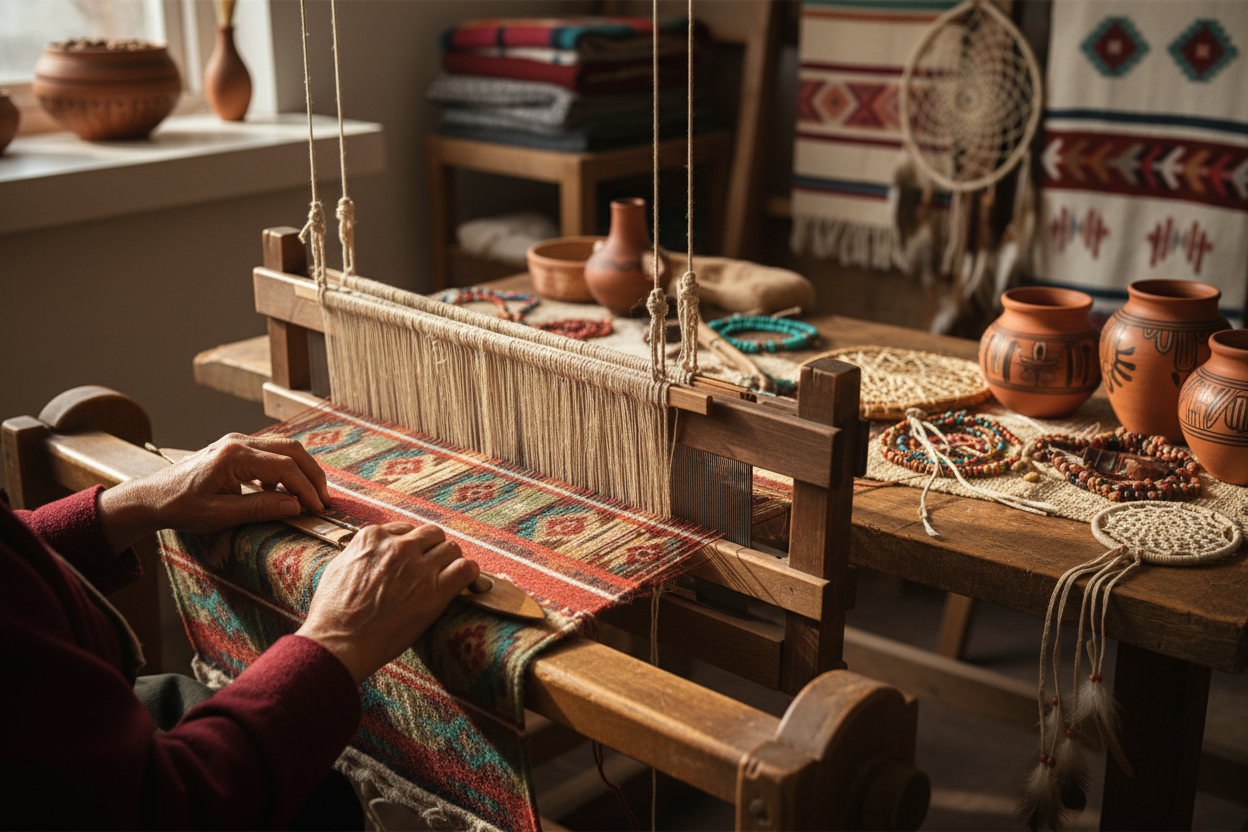
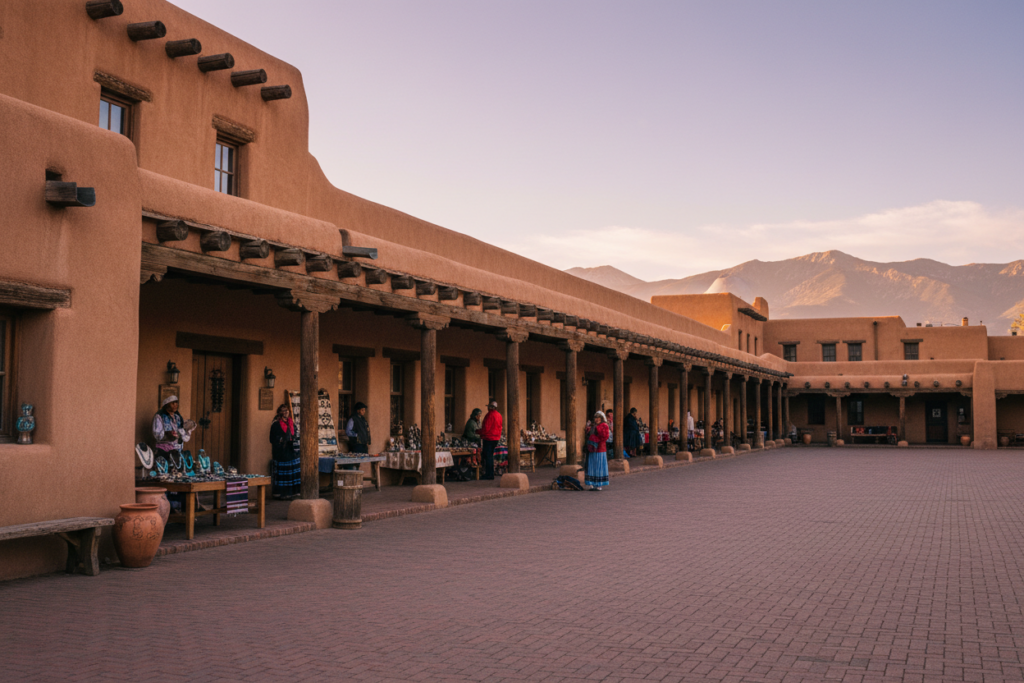
Today, the Plaza buzzes with activity as Native American artisans display their handcrafted jewelry, pottery, and textiles under the portal of the Palace of the Governors. This tradition, protected by city ordinance, ensures that only authentic Native American artists can sell their wares here, maintaining a connection to the area’s indigenous roots that predates Spanish colonization by thousands of years.
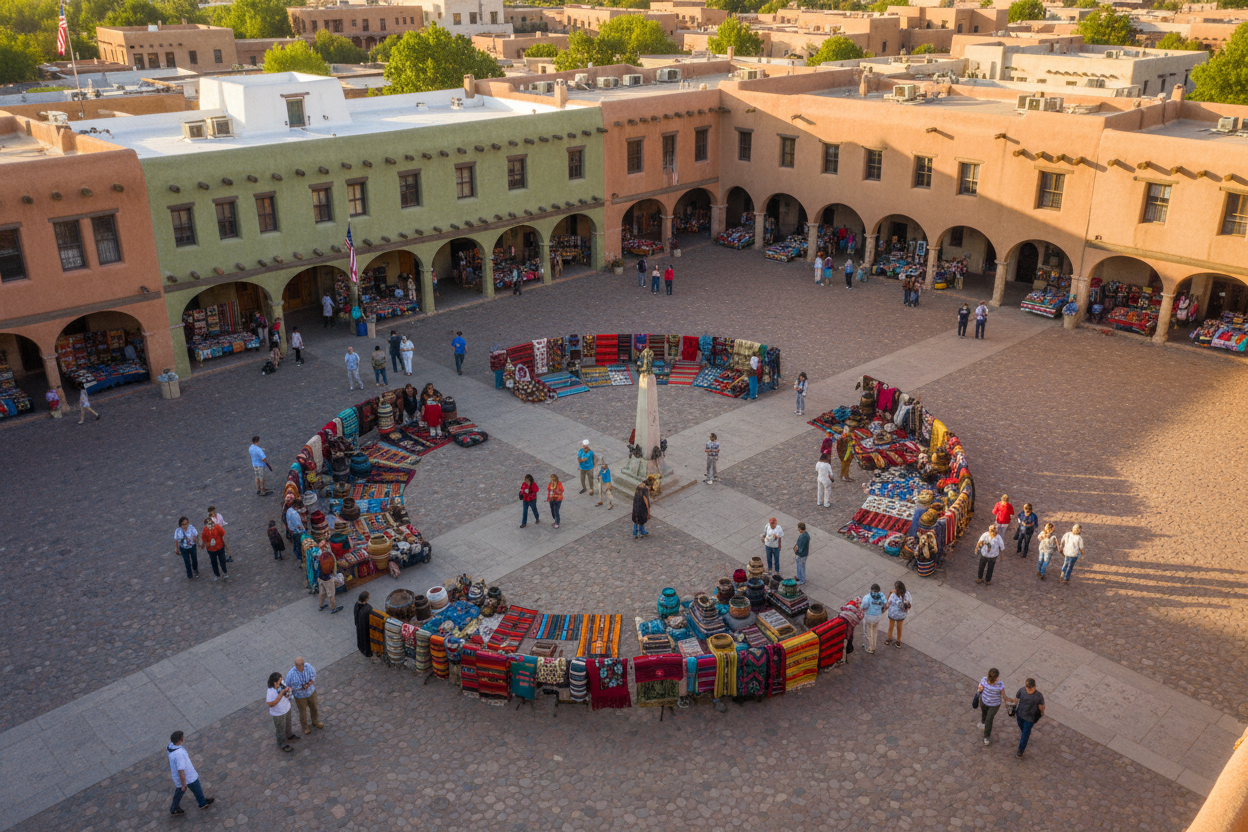
Discovering the Palace of the Governors Plaza
Adjacent to the main Plaza, the Palace of the Governors creates its own intimate plaza space along its lengthy portal. This covered walkway, supported by massive wooden posts, has sheltered countless generations of traders, officials, and visitors. The portal extends for nearly 400 feet, making it one of the longest such structures in the American Southwest.
Walking along this historic corridor, you’ll notice the subtle variations in the adobe construction that reveal different periods of renovation and expansion. The walls, some measuring up to four feet thick, were built using traditional techniques that involved mixing clay-rich soil with straw and water, then forming the mixture into bricks that were dried in the intense high-desert sun.
The Palace served as the seat of government for Spanish, Mexican, and American territorial administrations. General Stephen W. Kearny claimed New Mexico for the United States from this very building in 1846, and it continued to house territorial governors until 1886. Today, it operates as part of the New Mexico History Museum, offering visitors a chance to explore centuries of Southwestern history through carefully curated exhibits and artifacts.
San Miguel Plaza: Where Faith and Community Converge
A short walk southeast from the main Plaza leads you to San Miguel Plaza, a smaller but equally significant historic space centered around San Miguel Chapel. Built between 1610 and 1626, this humble adobe structure claims the title of the oldest church in the continental United States, making it a must-see destination on your walking tour.
The chapel’s plaza, though more modest in scale than the main Plaza, carries immense spiritual and historical significance. Spanish soldiers and settlers gathered here for worship, community meetings, and celebrations. The building’s thick adobe walls and simple design reflect the practical needs of early colonists who prioritized durability and functionality over elaborate ornamentation.
Inside San Miguel Chapel, you’ll discover a remarkable collection of religious art, including a stone reredos (altar screen) and several retablos (painted wooden panels) created by local santeros (saint makers). The chapel’s wooden vigas, some of which are original to the 17th century, support a roof that has weathered centuries of high-desert storms and blazing summer sun.
Barrio de Analco: The Original Neighborhood Plaza
Continuing your exploration, venture into the Barrio de Analco, Santa Fe’s oldest residential neighborhood. The name “Analco” comes from the Nahuatl language, meaning “on the other side of the water,” referring to its location across the Santa Fe River from the main Plaza. This area represents one of America’s oldest Hispanic neighborhoods, with some structures dating to the early 1600s.
The neighborhood’s informal plaza spaces developed organically around community needs rather than formal city planning. Here, you’ll find a more intimate scale of architecture and public space, where narrow streets and small courtyards create cozy gathering areas that have fostered neighborhood connections for generations.
The famous Oldest House in the USA, located on De Vargas Street, anchors this historic district. While the exact dating remains debated among historians, archaeological evidence suggests portions of the structure may date to the 1200s, with significant additions during the Spanish colonial period. The building’s plaza-facing facade showcases classic Santa Fe style architecture, with its low-profile design, flat roof, and characteristic brown adobe walls.
Cathedral Basilica Plaza: Where Cultures Blend
Your walking tour wouldn’t be complete without visiting the plaza area surrounding the Cathedral Basilica of St. Francis of Assisi. This impressive Romanesque Revival structure, completed in 1886, represents a fascinating architectural departure from Santa Fe’s predominantly adobe aesthetic. Archbishop Jean-Baptiste Lamy commissioned the cathedral’s construction as part of his efforts to bring European architectural styles to the American Southwest.
The cathedral’s plaza space reflects this cultural blending, where French architectural influences meet traditional Southwestern design elements. The surrounding area features a mix of historic adobe buildings and later Victorian-era structures, creating a unique architectural dialogue that tells the story of Santa Fe’s evolving cultural identity.
The small plaza in front of the cathedral often hosts community events, religious processions, and cultural celebrations. During the annual Fiesta de Santa Fe, this space becomes particularly vibrant as participants in traditional Spanish colonial and Mexican folk dances fill the area with colorful costumes and rhythmic music.
Walking Tour Tips and Practical Information
Planning your Santa Fe historic plazas walking tour requires some practical considerations to ensure the best possible experience. The high-desert climate means significant temperature variations between day and night, and the elevation of 7,199 feet above sea level may affect visitors from lower altitudes.
Start your tour early in the morning or late afternoon to avoid the intense midday sun and take advantage of the golden light that makes Santa Fe’s adobe architecture particularly photogenic. Comfortable walking shoes with good grip are essential, as some historic sidewalks and plaza surfaces can be uneven.
The entire walking tour covers approximately two miles and can be completed in 3-4 hours, depending on how much time you spend exploring each location. Consider bringing a water bottle, sunscreen, and a hat, especially during summer months when temperatures can exceed 85 degrees Fahrenheit.
Many of the historic buildings surrounding the plazas house museums, galleries, and shops. The New Mexico History Museum, Palace of the Governors, and various art galleries offer excellent opportunities to delve deeper into the region’s cultural heritage. Check operating hours in advance, as some attractions have seasonal schedules.
The Living History of Santa Fe’s Plazas
What makes Santa Fe’s historic plazas truly remarkable is their continued vitality as community gathering spaces. Unlike many historic districts that feel frozen in time, these plazas remain active centers of daily life, commerce, and cultural expression. The Plaza hosts numerous festivals throughout the year, including Indian Market, Spanish Market, and the famous Burning of Zozobra during Fiesta de Santa Fe.
Local residents still use these spaces much as their ancestors did – for socializing, conducting business, and celebrating important occasions. You might encounter everything from impromptu musical performances to political rallies, art installations to farmers’ markets. This ongoing use ensures that the plazas remain living monuments rather than mere tourist attractions.
The architectural preservation efforts in Santa Fe represent one of America’s most successful historic preservation stories. Strict building codes maintain the city’s distinctive aesthetic while allowing for modern functionality. New construction must conform to traditional materials and design principles, ensuring that the historic character remains intact for future generations.
Walking through Santa Fe’s historic plazas offers more than just a glimpse into the past – it provides an opportunity to experience the ongoing evolution of American culture. These spaces have witnessed the meeting of three major cultural traditions: Native American, Hispanic, and Anglo-American. The result is a unique cultural synthesis that continues to influence art, architecture, cuisine, and daily life throughout the Southwest.
Your journey through America’s oldest state capital reveals layers of history that extend far beyond the Spanish colonial period. Archaeological evidence suggests continuous human habitation in the Santa Fe area for over a thousand years, with various Pueblo peoples establishing communities along the Santa Fe River long before European contact. This deep history adds profound context to your plaza walking tour, reminding visitors that Santa Fe’s story begins long before 1610.
As you conclude your walking tour of Santa Fe’s historic plazas, take a moment to appreciate the remarkable continuity these spaces represent. From ancient Native American trading posts to Spanish colonial administrative centers, from Mexican territorial capitals to American statehood, these plazas have adapted and endured. They stand as testament to the resilience of human community and the power of place to shape cultural identity across centuries. Whether you’re a history enthusiast, architecture lover, or simply someone seeking to understand the roots of American Southwest culture, Santa Fe’s historic plazas offer an unparalleled window into the nation’s diverse and complex heritage.
Frequently Asked Questions
How long does it take to complete the historic plazas walking tour?
The complete walking tour typically takes 3-4 hours, covering approximately 2 miles. However, you can easily spend a full day if you include museum visits, shopping, and dining at the various plazas.
Is the walking tour suitable for people with mobility limitations?
Most of the plazas are accessible, though some historic sidewalks may be uneven. The main Plaza and Cathedral area are the most accessible, while some areas in Barrio de Analco have more challenging terrain.
What’s the best time of year to visit Santa Fe’s historic plazas?
Spring through fall offers the best weather, with May through October being particularly pleasant. Winter can be cold with occasional snow, but the plazas take on a magical quality during the holiday season.
Are guided tours available for the historic plazas?
Yes, several companies offer guided walking tours, and the Palace of the Governors provides free docent-led tours. Self-guided tour maps are also available at the visitor center.
Can I visit San Miguel Chapel and other historic buildings?
Most historic buildings charge small admission fees. San Miguel Chapel, the Palace of the Governors, and the Cathedral are open to visitors, though hours vary seasonally.
Where should I park for the walking tour?
Several parking options exist near the Plaza, including metered street parking and paid lots. The Eldorado Hotel and other businesses offer parking, though spaces can be limited during peak tourist seasons.