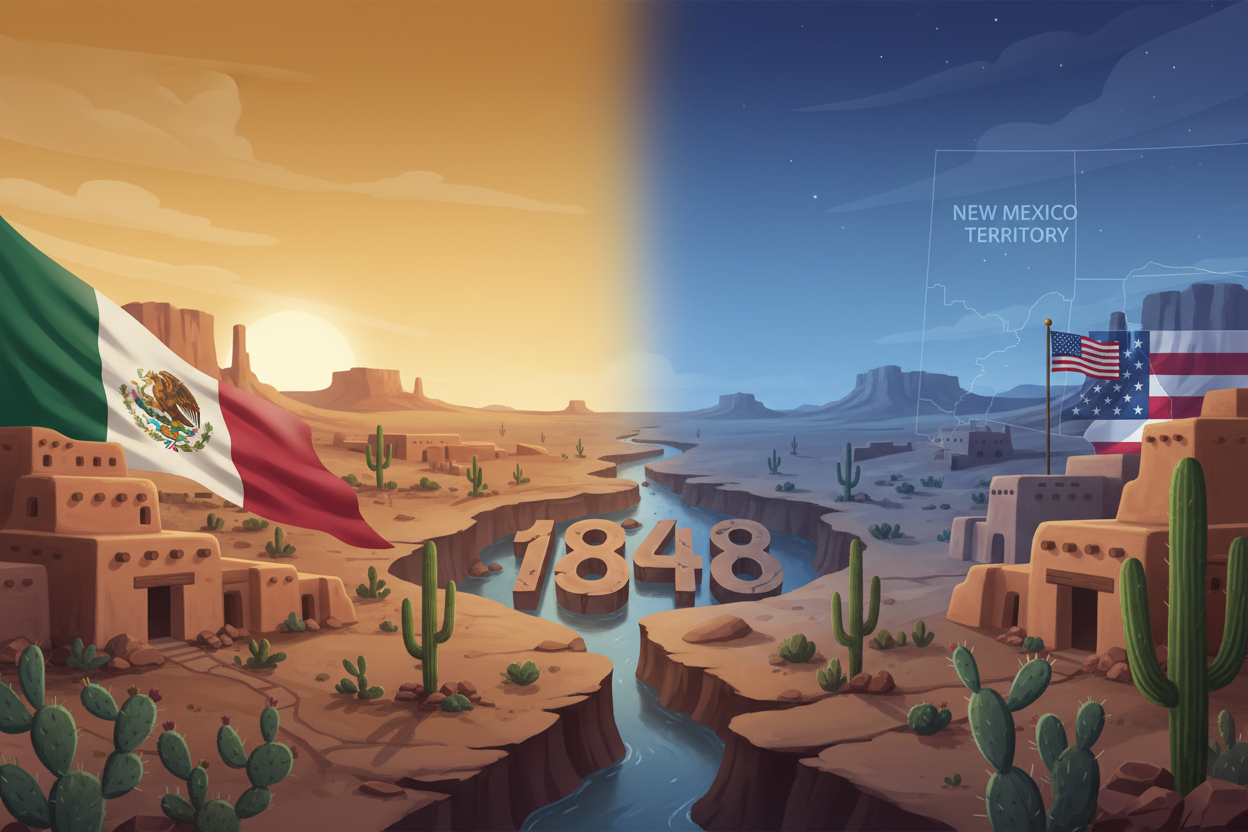
Mexican American War Impact: How 1848 Changed New Mexico Forever
Picture this: one day you’re living in Mexican territory, speaking Spanish, following Mexican laws, and practicing centuries-old traditions. The next day, after the stroke of a pen thousands of miles away, you’re suddenly an American citizen. This dramatic transformation wasn’t fiction—it was reality for thousands of New Mexicans in 1848 when the Treaty of Guadalupe Hidalgo ended the Mexican-American War and forever altered the destiny of the American Southwest.
The Mexican-American War may have lasted only two years, but its impact on New Mexico continues to reverberate through the region today. From land ownership disputes to cultural preservation battles, from language rights to economic development, the events of 1848 created ripple effects that shaped everything we know about modern New Mexico.
The Mexican-American War: Setting the Stage for Transformation
The Mexican-American War erupted in 1846, born from territorial disputes and America’s belief in Manifest Destiny—the idea that the United States was destined to expand across the North American continent. While most of the fighting occurred in Texas and central Mexico, New Mexico found itself caught in the crosshairs of this continental power struggle.
General Stephen W. Kearny’s Army of the West marched into Santa Fe in August 1846, claiming the territory for the United States without firing a single shot. The relative ease of this conquest masked the complexity of what would follow. New Mexico wasn’t just changing flags; it was about to undergo a complete social, legal, and economic transformation that would challenge everything its residents knew about their world.
The war officially ended on February 2, 1848, with the signing of the Treaty of Guadalupe Hidalgo. This document didn’t just end hostilities—it redrew the map of North America and set in motion changes that would define New Mexico’s character for generations to come.
The Treaty of Guadalupe Hidalgo: Promises Made and Broken
The Treaty of Guadalupe Hidalgo appeared generous on paper. It promised that Mexican citizens living in the newly acquired territories could become American citizens while retaining their property rights, religious freedom, and cultural practices. For New Mexicans, these promises seemed to offer the best of both worlds—American citizenship with protection for their traditional way of life.
However, the reality proved far more complicated. The treaty’s implementation revealed the gap between diplomatic promises and ground-level realities. While some provisions were honored, others became sources of decades-long conflicts that fundamentally altered New Mexican society.
The language barrier immediately created problems. Legal documents, court proceedings, and government communications shifted to English, putting Spanish-speaking residents at a significant disadvantage. Many New Mexicans found themselves navigating an unfamiliar legal system that operated in a foreign language, setting the stage for misunderstandings and exploitation.
Land Rights Revolution: From Communal to Individual Ownership
Perhaps no aspect of post-1848 life changed more dramatically than land ownership patterns. Under Mexican rule, New Mexico operated under a system of communal land grants that had roots stretching back to Spanish colonial times. These grants supported entire communities, providing grazing land, farming areas, and natural resources that families had used for generations.
American legal traditions, however, emphasized individual property rights and required detailed documentation to prove ownership. This fundamental difference created a perfect storm of confusion and conflict. Many New Mexican families possessed land through oral traditions, community agreements, or Spanish-language documents that American courts didn’t recognize or understand.
The result was catastrophic for many Hispanic families. Unscrupulous lawyers and land speculators exploited the confusion, often convincing families to sign away their rights in exchange for legal representation or immediate cash payments. By some estimates, Hispanic New Mexicans lost over 80% of their traditional lands in the decades following 1848.
The Sangre de Cristo Land Grant case exemplifies these struggles. This massive grant, covering over one million acres, became entangled in legal battles that lasted well into the 20th century. Families who had lived on and worked the land for generations found themselves dispossessed, forced to become laborers on property their ancestors had owned.
Cultural and Linguistic Transformation
The arrival of American governance brought pressure for cultural assimilation that many New Mexicans had never experienced under more tolerant Mexican rule. English became the language of government, business, and increasingly, education. Spanish, which had dominated the region for centuries, was gradually pushed into domestic and informal settings.
This linguistic shift had profound implications beyond mere communication. Language carries culture, traditions, and ways of understanding the world. As English gained prominence, traditional knowledge systems, oral histories, and cultural practices faced new challenges to their survival.
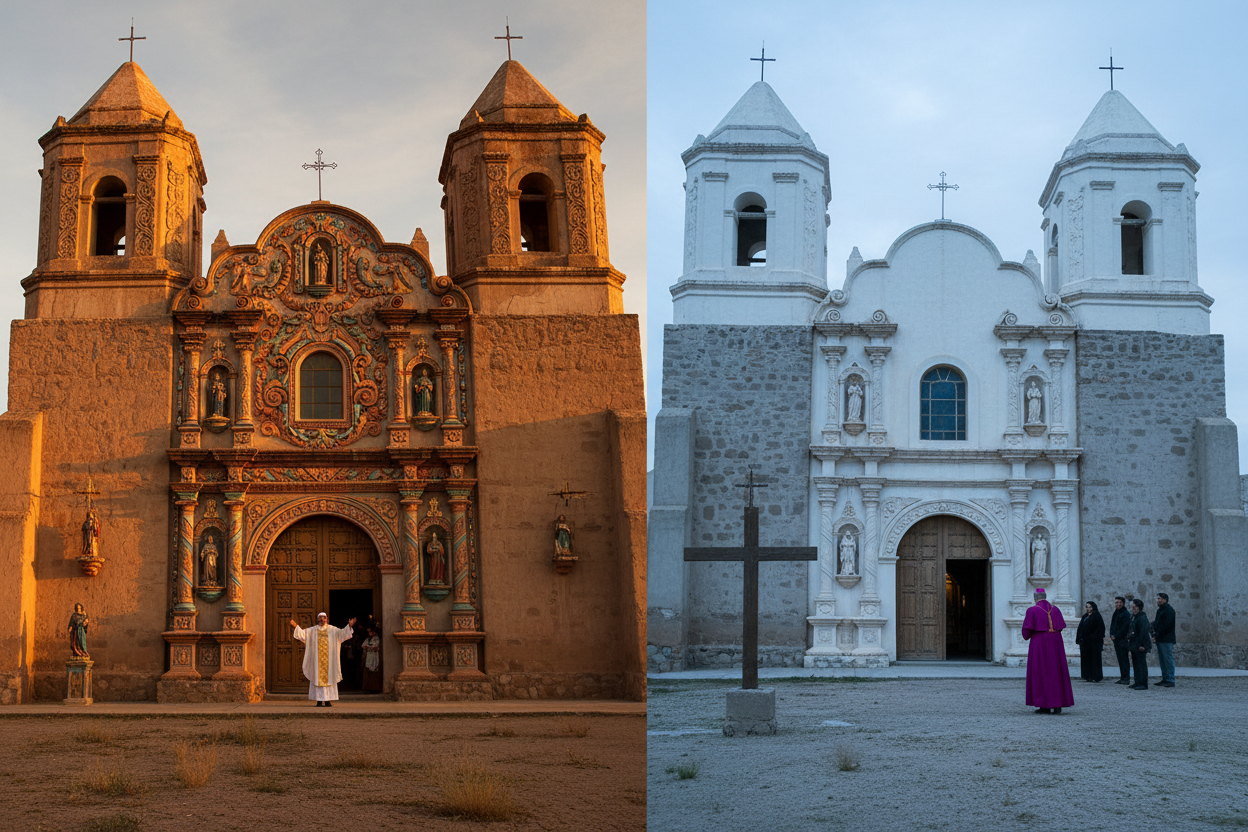
Religious practices also evolved during this period. While the Treaty of Guadalupe Hidalgo guaranteed religious freedom, the reality was more nuanced. The Catholic Church, which had been the dominant religious institution under Mexican rule, suddenly found itself operating within a predominantly Protestant nation. American bishops gradually replaced Mexican clergy, and church policies began reflecting American Catholic traditions rather than Mexican ones.
Despite these pressures, New Mexican communities showed remarkable resilience in preserving their cultural identity. Families maintained Spanish as their primary language, continued traditional celebrations like Las Posadas and Día de los Muertos, and adapted their practices to survive within the new American framework.
Economic Upheaval and New Opportunities
The transition to American rule brought both opportunities and challenges to New Mexico’s economy. The arrival of American merchants and the expansion of trade routes connected New Mexico to broader American markets, creating new possibilities for commerce and growth.
The famous Santa Fe Trail, which had operated during Mexican rule, expanded dramatically under American administration. This increased trade brought new goods, ideas, and people to New Mexico, gradually transforming local economies from subsistence-based to market-oriented systems.
However, these economic changes often benefited newcomers more than established residents. American merchants, backed by better access to credit and familiar with American business practices, frequently outcompeted local traders. Many traditional New Mexican businesses struggled to adapt to new regulations, tax systems, and commercial practices.
The territorial period also saw the beginnings of large-scale mining and ranching operations that would later define much of New Mexico’s economy. While these industries created jobs and attracted investment, they also accelerated the concentration of land ownership and natural resources in fewer hands, often at the expense of traditional communities.
Political Representation and the Path to Statehood
New Mexico’s political status remained uncertain for decades after 1848. Unlike Texas, which joined the Union relatively quickly, New Mexico faced significant obstacles to statehood that reflected broader American anxieties about incorporating a predominantly Hispanic, Spanish-speaking population.
The territorial government established in 1850 created a complex political situation. New Mexicans could participate in local governance, but ultimate authority rested with federally appointed officials who often had little understanding of local conditions or cultures. This arrangement created tensions between federal policies and local needs that persisted throughout the territorial period.
The question of slavery further complicated New Mexico’s path to statehood. As national tensions over slavery intensified in the 1850s, New Mexico’s status became entangled in broader sectional conflicts. The territory’s ambiguous position on slavery made it a political football in national debates, delaying statehood for decades.
When New Mexico finally achieved statehood in 1912, it did so with a constitution that reflected the unique compromises necessary to balance Anglo and Hispanic interests. The state constitution included provisions protecting Spanish language rights and recognizing community land grants—acknowledgments of the ongoing influence of the 1848 transformation.
Long-term Legacy: Modern New Mexico’s Foundations
The changes initiated in 1848 established patterns that continue to influence New Mexico today. The state’s unique trilingual heritage—English, Spanish, and various Native American languages—reflects the complex cultural negotiations that began with the Treaty of Guadalupe Hidalgo.
Modern New Mexico’s approach to land and water rights still bears the imprint of 19th-century conflicts. Contemporary disputes over acequia (irrigation ditch) rights, community land grants, and natural resource management often trace their origins to the legal and cultural transformations that followed 1848.
The state’s distinctive political culture, which often emphasizes consensus-building and cultural accommodation, developed partly as a response to the need to balance diverse community interests in the post-1848 period. New Mexico’s reputation for political pragmatism and cultural tolerance has roots in the survival strategies developed during the territorial period.
Conclusion: Understanding New Mexico Through Historical Transformation
The Mexican-American War’s end in 1848 marked more than just a change in sovereignty for New Mexico—it initiated a comprehensive transformation that touched every aspect of life in the territory. From the courthouse to the classroom, from the marketplace to the family dinner table, the ripple effects of that distant war reshaped how New Mexicans lived, worked, and understood their place in the world.
The story of post-1848 New Mexico is neither a simple tale of American progress nor a narrative of cultural destruction. Instead, it’s a complex account of adaptation, resistance, loss, and survival that created the unique character we associate with New Mexico today. Understanding this transformation helps us appreciate both the challenges and the resilience that define New Mexican identity.
As we look at modern New Mexico—its distinctive architecture, its trilingual signs, its blend of traditions, and its ongoing struggles with land and water rights—we’re seeing the living legacy of 1848. The Mexican-American War may have ended over 170 years ago, but its impact on New Mexico continues to unfold, reminding us that historical events don’t just stay in the past—they shape the present and influence the future in ways both obvious and subtle.
Frequently Asked Questions
What exactly did the Treaty of Guadalupe Hidalgo promise New Mexicans?
The treaty promised that Mexican citizens in the acquired territories could become American citizens within one year, retain their property rights, practice their religion freely, and maintain their cultural traditions. However, many of these promises were poorly implemented or ignored entirely.
How much land did Hispanic New Mexicans actually lose after 1848?
Historians estimate that Hispanic New Mexicans lost approximately 80% of their traditional lands in the decades following 1848, primarily due to legal complications, language barriers, and exploitation by land speculators and unscrupulous lawyers.
Why did it take so long for New Mexico to become a state?
New Mexico didn’t achieve statehood until 1912, partly due to national concerns about incorporating a predominantly Hispanic, Spanish-speaking population, complications related to the slavery debate, and periodic conflicts with Native American tribes that made the territory seem unstable to federal officials.
How did the 1848 changes affect Native American tribes in New Mexico?
Native American tribes faced intensified pressure under American rule, with more aggressive military campaigns, forced relocations like the Long Walk of the Navajo, and systematic attempts to suppress traditional cultures through boarding schools and other assimilation programs.
What aspects of pre-1848 culture survived in New Mexico?
Many cultural elements survived, including the Spanish language, traditional architecture, religious celebrations, acequia irrigation systems, and community-based social structures. New Mexico today remains the most Hispanic state in the U.S., reflecting this cultural continuity.
How did the economic systems change after 1848?
The economy shifted from primarily subsistence-based and local trade to market-oriented capitalism connected to broader American markets. This brought new opportunities but often displaced traditional economic practices and concentrated wealth among newcomers rather than established residents.