El Morro Inscription Rock: Reading History Written in Stone
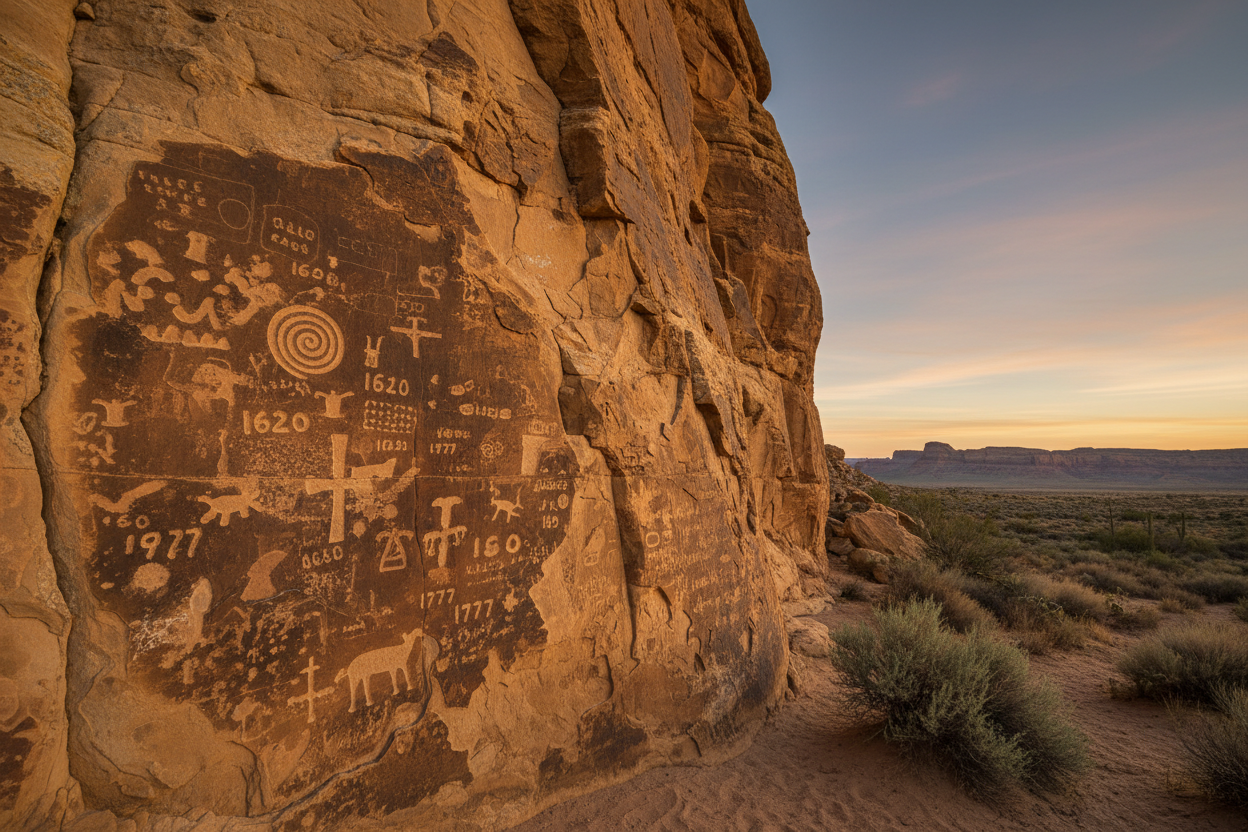
Imagine walking through the New Mexico desert and stumbling upon a massive sandstone bluff covered in centuries-old graffiti. This isn’t vandalism—it’s living history. El Morro National Monument, also known as Inscription Rock, stands as one of America’s most fascinating outdoor museums, where travelers have been leaving their mark for over 700 years.
Rising 200 feet above the desert floor, this towering monolith has served as a natural guestbook for countless souls who passed through this remote corner of the Southwest. From ancient Ancestral Puebloans to Spanish conquistadors, from Mexican traders to American pioneers, each group left behind messages that tell the story of human movement across this challenging landscape.
The Ancient Canvas: Understanding El Morro’s Geological Foundation
Before we dive into the human stories carved into its surface, let’s appreciate the rock itself. El Morro formed millions of years ago when this region lay beneath ancient seas. Layers of sediment compressed over time, creating the distinctive Zuni Sandstone that makes up the bluff today.
What makes El Morro particularly special for inscription preservation is the nature of this sandstone. It’s soft enough to carve with simple tools, yet durable enough to withstand centuries of weathering. The rock face that contains most inscriptions faces north, protecting the carvings from the harsh southwestern sun that might otherwise cause more rapid deterioration.
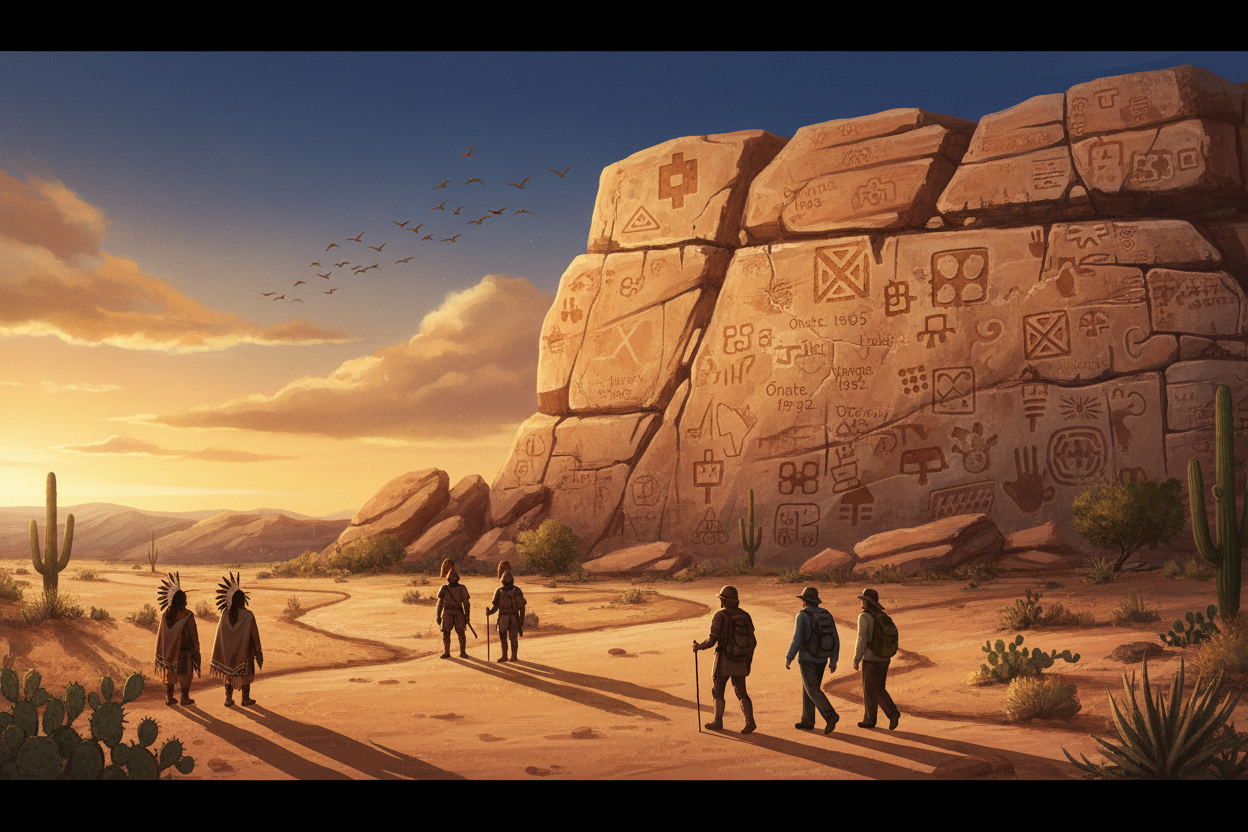
At the base of this imposing cliff lies a natural pool—a precious water source that drew travelers to this spot for millennia. This reliable water made El Morro a crucial waystation along ancient trade routes and later colonial pathways.
Ancestral Voices: The Earliest Inscriptions at El Morro
The oldest human marks at El Morro date back to around 1200-1400 CE, left by Ancestral Puebloan peoples. These aren’t words as we might recognize them, but rather petroglyphs—images carved into the rock face that communicate through symbols and pictures.
Walking along the base of the cliff today, you can still see these ancient communications: spirals that might represent journeys or time cycles, animal figures that could indicate hunting success or spiritual visions, and geometric patterns whose meanings remain mysteries. These petroglyphs remind us that the human desire to leave a mark, to say “I was here,” transcends cultures and centuries.
The Ancestral Puebloans also built settlements atop El Morro, taking advantage of the natural fortress-like qualities of the mesa. Ruins of these ancient villages still exist, accessible via hiking trails that offer visitors a chance to see where these early inhabitants lived and worked.
Spanish Conquistadors Leave Their Mark
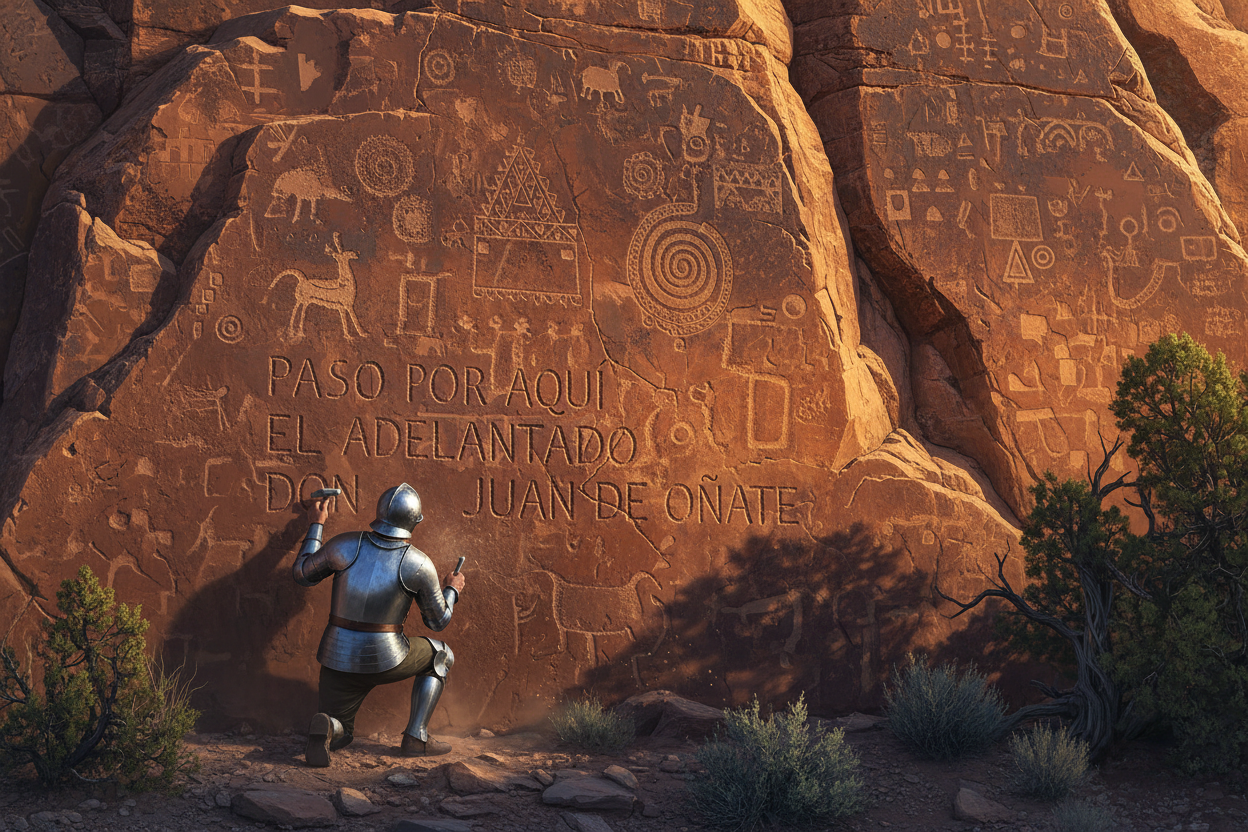
The character of inscriptions at El Morro changed dramatically in 1605 when Spanish explorer Don Juan de Oñate carved the first European message into the rock. His inscription, still clearly visible today, reads: “Pasó por aqui el adelantado Don Juan de Oñate del descubrimiento de la mar del sur a 16 de abril de 1605” (Passed by here the Governor Don Juan de Oñate, from the discovery of the South Sea, the 16th of April, 1605).
Oñate’s inscription marked the beginning of a Spanish tradition at El Morro. For the next two centuries, Spanish officials, missionaries, and soldiers would stop at this natural waystation and add their names to the growing collection. These inscriptions provide invaluable historical documentation of Spanish colonial expeditions and the establishment of missions throughout the Southwest.
Many Spanish inscriptions follow a similar format, noting the date of passage and often including religious references. Some mention specific expeditions or military campaigns, offering historians concrete evidence of Spanish activities in this remote region. The formal, often elaborate nature of these carvings reflects the Spanish colonial administration’s emphasis on documentation and territorial claims.
American Pioneers and the Changing Frontier
As Mexican independence in 1821 opened new trade opportunities, and later as American territorial expansion reached the Southwest, El Morro’s inscription collection grew to include new voices. American traders, military personnel, and settlers began adding their names alongside the Spanish inscriptions, creating a multilingual historical record.
The California Gold Rush brought increased traffic through the area, and many forty-niners stopped to carve their names and dates. These inscriptions often reflect the hurried, practical nature of American westward expansion—simple names and dates rather than the more elaborate Spanish formal inscriptions.
One of the most famous American inscriptions comes from Lieutenant James H. Simpson, who led a military expedition through the area in 1849. Simpson not only left his name on the rock but also conducted the first systematic study of El Morro’s inscriptions, documenting and sketching many of the Spanish carvings. His work provides crucial historical context for understanding the site’s significance.
Preserving History: El Morro Becomes a National Monument
By the early 20th century, historians and archaeologists recognized El Morro’s unique value as a historical document. In 1906, President Theodore Roosevelt designated El Morro as a National Monument, ensuring its protection for future generations.
This designation came just in time. As tourism to the Southwest increased and access to remote areas became easier, El Morro faced the threat of modern vandalism. The National Park Service implemented strict protections, making it illegal to add new inscriptions while working to preserve the existing historical carvings.
Today, conservation efforts at El Morro involve careful monitoring of the inscriptions, documentation projects to create detailed records of all carvings, and ongoing research to better understand the historical context of various inscriptions. Advanced techniques like 3D scanning help preserve exact records of the inscriptions while allowing researchers to study details that might be invisible to the naked eye.
Reading the Stories: What El Morro’s Inscriptions Tell Us
Each inscription at El Morro represents a moment in time, a individual story within the larger narrative of American expansion and cultural interaction. Together, they create an unparalleled record of human movement across the Southwest over seven centuries.
The Spanish inscriptions document the systematic exploration and colonization of the region, showing how colonial administrators maintained communication and established territorial control. The religious references in many Spanish carvings reflect the important role of Catholic missions in colonial expansion.
American inscriptions from the 19th century tell different stories—of individual opportunity-seekers heading to California goldfields, of military expeditions mapping and securing new territories, of traders establishing commercial networks across the expanding nation. The contrast in inscription styles reflects broader cultural differences between Spanish colonial administration and American frontier individualism.
Perhaps most importantly, El Morro’s inscriptions demonstrate the continuity of human experience across cultures and centuries. Whether Ancestral Puebloan, Spanish, Mexican, or American, all who passed this way felt compelled to leave some record of their passage, to communicate across time with future travelers.
Visiting El Morro Today: A Journey Through Time
Modern visitors to El Morro National Monument can walk the same trails used by centuries of travelers, seeing the inscriptions up close while learning about their historical context. The monument offers two main hiking trails: the Inscription Rock Trail, a easy half-mile loop that passes the major inscription areas, and the Mesa Top Trail, a more challenging two-mile hike that leads to the ancient Ancestral Puebloan ruins.
The visitor center provides essential context for understanding what you’ll see on the trails, with exhibits explaining the different periods of inscription-making and the historical significance of various carvings. Park rangers offer interpretive programs that bring the stories behind the inscriptions to life.
Photography is encouraged, but visitors must remember that these inscriptions are irreplaceable historical artifacts. The “leave only footprints” principle is especially important here—adding new inscriptions is not only illegal but also damages the historical integrity of this unique site.
Conclusion: The Enduring Legacy of Inscription Rock
El Morro Inscription Rock stands as more than just a collection of old graffiti—it’s a testament to the human need to communicate across time and space. In our digital age, where messages disappear with the swipe of a finger, there’s something profoundly moving about these permanent marks carved into stone by people who wanted to be remembered.
The inscriptions at El Morro remind us that history isn’t just about famous people and major events—it’s also about ordinary individuals making their way across challenging landscapes, taking time to leave a message for future travelers. These stone signatures connect us directly with the past, allowing us to touch the same rock surface that Spanish conquistadors and American pioneers once carved.
As we face our own uncertain future, El Morro’s message is clear: people have always been on the move, always seeking new opportunities, always hoping to leave something behind that says they mattered. In preserving and interpreting these inscriptions, we honor not just the specific individuals who made them, but the broader human story of movement, adaptation, and the eternal desire to communicate across the barriers of time.
Frequently Asked Questions
Q: How old are the oldest inscriptions at El Morro?
A: The oldest inscriptions are Ancestral Puebloan petroglyphs dating from approximately 1200-1400 CE. The oldest European inscription was carved by Don Juan de Oñate in 1605.
Q: Can visitors still add their own inscriptions to El Morro?
A: No, adding new inscriptions has been illegal since El Morro became a National Monument in 1906. Violating this rule can result in serious fines and criminal charges.
Q: What languages are represented in the inscriptions?
A: The inscriptions include Ancestral Puebloan petroglyphs (symbolic rather than linguistic), Spanish, and English. There are over 2,000 documented inscriptions in total.
Q: How long does it take to visit El Morro?
A: The basic Inscription Rock Trail takes about 30-45 minutes to walk. If you include the Mesa Top Trail to see the ancient ruins, plan for 2-3 hours total.
Q: What’s the best time of year to visit El Morro?
A: Spring and fall offer the most comfortable weather. Summer can be very hot, while winter may bring snow and ice that can make trails dangerous. The monument is open year-round, but check conditions before visiting.
Q: Are the inscriptions still readable after all these years?
A: Many inscriptions remain clearly visible, particularly those on the north-facing cliff that’s protected from direct sunlight. Some have faded over time, but ongoing conservation efforts help preserve them for future generations.